Thursday, November 03, 2005

Trios...


This week I picked out two trios at random, one English, one American. The English trio (and duo) are much more collective affairs, surprisingly maybe, given Paul Dunmall's strengths as a soloist. Both trios have also dispensed with bass. Compare and contrast, as they say...

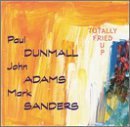
The English group, fetched up on the independent label that George Haslam runs: Slam, consists of Paul Dunmall, John Adams and Mark Sanders on tenor, electric guitar and drums respectively, who recorded the cd 'All Fried Up' in March 1998. I've given two tracks, a short one by the trio and a longer one by Dunmall and Adams without the drummer. There is the odd taste of Coltrane in the saxophonist's playing, which is probably unavoidable, coming out of the tradition and also playing in Alice Coltrane's band when he was resident in the US for three years – but Dunmall has his own firm stamp, has developed his style over the years to fit the diverse contexts he plays in and still remain his own man. (Alan Skidmore, say, would be your candidate for full-throttle Coltraneing in a Coltrane tribute band - a bit unfair, maybe... come to think of it, they played together in a two hard tenor group back in the eighties if I remember correctly...). Dunmall has honed his playing into an individual, free blowing style and can be heard in many different line-ups – he has also recorded a large amount of material most of which is still
available –
here's a good selection that demonstrates his musical fecundity...

He is also a player I have admired since he made his bones in a long tenure with 'Spirit Level' way back, right through to his later incarnations with the likes of Keith Tippett, the London Jazz Composers Orchestra - and not to forget the bagpipe explorations...

'Totally Fired Up' starts with Dunmall in frenetic, hard-squalling mode – a literal echo of the title? - underpinned by choppy chords from the guitar and Sanders' sure-footed drums – this is a democracy of horn, guitar and drums, equally sonically balanced, that ends abruptly on a couple of deep, blatted tenor notes.

The second track, a duo: 'Captured a Rapture'. They start slowly – Dunmall plays long notes low down and ruminative as Adams starts to build a framework eventually picking a faster lattice work of notes round him, progressing to swift chording alternating with single note runs – an abstraction of traditional 'comping.' Dunmall speeds up – yet Adams matches him as they build longer lines that cross and inflect, parallel and veer. Two instruments and no rhythm section – yet there are not many gaps – a very full sound world invoked here. Dunmall goes into the higher register as the track progresses and the lines combine and contrast to end almost abruptly again on a bunch of ascending chords.

The Americans: Jimmy Lyons leading his partner Karen Borca on oboe and drummer Paul Murphy on a track from the recent retrospective 5 cd set on the Ayler label.

Jimmy Lyons was known much more for his long tenure with Cecil Taylor than for being a leader – yet the release of the boxed set that this track comes from demonstrates many other facets of his work, outside the wild and wooly world of Cecil. "Jump Up" was recorded in Geneva in May 1984 with bassoonist Karen Borca and drummer Paul Murphy and could almost be an Ornette Coleman tune or a speeded up Albert Ayler number, briefly stated by the alto and bassoon before Lyons launches into a fast, fluid boppy solo over the busy drums- the long rat-tatting snare patterns of which remind me of Sunny Murray. One thing you notice very quickly is his ability to articulate accurately even very short note durations at speed. If he smears a note – it is intentional emotional colouring rather than a slip of the embouchure and fingers. This is Charlie Parker taken into the dimensions of 'free jazz' – some hint of what might have been if the Bird had lived? One wonders... Lyons came strongly out of Bird but by this time had long established himself as a master saxophonist, an underrated one due to his years with Taylor no doubt – yet Cecil had a great deal of respect for the man, regarding him as his 'right arm' during their long and fruitful association up to Lyons' tragic death in 1986. And Taylor's band must have a been a hard school to survive in – it is to Lyon's credit that he developed such successful saxophone strategies to play against the sheer density and speed of the pianist's sound world. These were in place early on... If you listen to the sessions recorded at the Cafe Monmartre the shadow of Bird is still very strong – but Lyons more than holds his own. Contrast Archie Shepp when he recorded with Taylor – he sounds uneasy and floundering.
Karen Borca complements the alto player well, plays a longer solo, long fluid lines, a deeper sound, coming close at times to resembling a baritone sax. The drummer plays back a bit behind her, in contrast to his busy work behind Lyons. The drum solo is interesting in that it continues the rhythmic feel of the track – long, fast almost smooth lines – a very linear approach compared to Taylor's music. Marsh is rolling long patterns on toms and snare that reflect the horns playing. This particular trio is also contrasted to the Dunmall et al track by its emphasis on solo work – almost a traditional conception of brief head, solos then reprise the head. Bop taken on further by different means? A conscious homage? I figure that Lyons's solos are not so different in his work outside Taylor's group from those he played with the pianist - give or take a few contextual re-adjustments - which says a lot about the metalanguage of the saxophone that he developed so successfully. And the speed of thought melded to ferocious technique necessary to be comfortable in both worlds. Lyons' work repays much study and the Ayler cd set is a belated tribute to an undersung master.

Two different trios, then, led by underrated musicians, one dead, the other still going and blowing strong. Check out the bagpipes sometime (I kid you not - brilliant!)


Paul Dunmall Trio:

download – all fried upmp3 -


download- capture a rapturemp3
buy


Jimmy Lyons Trio
download - jump upmp3


buy

Wednesday, November 02, 2005

Club Sporadic - Saturday 22 October - Black Carrot...

The travails of a club curator... (hey, I love that phrase: club curator... rolls off the tongue...) Maybe this game is some kind of addiction – lying in bed at 5 pm Saturday afternoon when you have to be up and doing very soon and you just want to sleep because you had 4 hours the night before and you know that there is no way out: a club curator has to do the gig, whatever... Especially when you are performing as well, opening the show with one person whom you know well as a player – but the other you don't and you get that feeling: am I able to acquit myself well enough given exhaustion etc and this guy is supposed to be good and... in the event it's the old addiction kicking in: the club jones, the muso jones – the improv jones where you have nothing to fall back on if you play honestly – and the best part of the addiction is exactly that you have to play honestly and as fresh as possible to get the hit. And you need the hit – and you get the jolt – when you can sit back finally at 00.23 am which is relatively early for apres-gig back in your own sweet hovel with a can of Budweiser cold out of the fridge. Time to reflect on – well, what made the night so damn good? Apart from meeting and playing with a new musician – Michael – who had to rush off to Leeds but made a significant impression on me and those who heard him play with myself and David Teledu (whom God preserve!). I met and heard a new band to me: Black Carrot from Market Harborough – brothers in the game of provincial music making of the free and improvised and experimental variety. Second gig I've been at this week (third if you count my bizarre encounter with the Basford Variety Club which I still haven't written up – I need a quiet day dedicated to deciphering the records - scraps of paper, scribbles on beer mats - the usual - which has not turned up yet). And as good in a small east midlands club as the Jandek gig in the big city was: a tight, punchy band who play mainly improvised sets and songs. Black Carrot... You can guess by now that I liked them...

Plexus in its incarnation of myself and David Teledu plus guest Michael Canning opened the show and had decided to play as a unit rather than split up into various line-ups – due to time as much as anything else – and space: the Sporadic is a small club and there was a lot of equipment scattered around. We marshalled guitars, bass, synths, laptop and borrowed drums at the end to perform two pieces, one by David, the other by myself. Loose sketches, giving a basic tonality (C and G respectively) for each piece and suggestions on how to move through together. (I have received a cd recording of the set from David subsequently and played it back once – to me it sounds very good, but reviewing your own music is somewhat fraught with danger! I'll leave it at this – ) Michael Canning added some wonderful touches to our improvisation, at the end moving onto drums to give added rhythmic colour. David was prolific, switching instruments and colorations and I mainly thumped away at the lap top although I moved onto guitar at one point when the drums started as I felt the laptop could not respond quickly enough to what I wanted to add to the rhythms.

Black Carrot
are a three piece, drums, acoustic bass and keyboards doubling (trebling?) sax, bass recorder (I think) and electric guitar. They started with arco bass and electric keyboard – low sounds and high ringing clusters. The bass went into a pizzicato keening, singing section and the drummer edged in on cymbals – a jazzy 4/4 ching-ching-ker-ching type rhythm with bluesy keyboard. Then vocals added – a loose duet between the bass and keyboard player – words blurred and bent to be fairly incomprehensible (buy their cd – some of the same tracks are on it and you can find the lyrics written here as well!). A unique sound, I think - I have heard them compared to Morphine but personally don't hear it... the acoustic bass gives them a jazzier feel, for a start and Morphine are a bit one-dimensional whereas Black C have several strings to their various bows. They play long stretched-out numbers (like us) which gives plenty of space for improvising. I am a fan of long songs live or otherwise as I'm always curious on what journey I'm going to be taken on – this was a very interesting ride and one that I would like to experience again...

Further numbers brought in sax – punchy, free-jazzish, using what sounded like pedal effects at times to double the line – and the (probable) bass recorder and electric guitar - I had to go and get a drink (well, it had been a long day for little me...)so missed some of this last but came back to hear e-bowed guitar – long, sad singing notes which added another dimension to their varied sound world. A crisp and sharp unit, dedicated to the virtues of improvisation and also incredibly nice people. Hard actually to categorise them easily – which is to the good. This is music that has the rigour of improvisation done well but also is accessible via the jazzy rhythms (at times they reminded me of a New York-style band like Defunct or James Chance and the Contortions, maybe, from the punk jazz/loft side of the no-wave days).


There are things stirring out in the provincial undergrowth beyond the capital city... Loughborough... Market Harborough... tomorrow the world...

You can buy their cd: 'Cluk' – here -

Wednesday, October 26, 2005

Oliver and Albert...

This time round: two sax players. Albert Ayler is one of the sixties firebrands who probably is still one of the last to be understood comprehensively and whose legacy is yet to be satisfactorily defined – aided by the fact he died young in tragic circumstances, with so many disparate musical threads left dangling. Oliver Nelson went on to become a well-respected composer/arranger, but his initial recordings were made with Eric Dolphy whose explorations splintered the walls of jazz harmony without bursting through totally into free-form freakout – but who also died tragically young – again, prompting speculation of what might have been... Dolphy is also present on the, undisputed I would say, masterpiece that Nelson recorded in 1961: 'The Blues and the Abstract Truth.' A stellar lineup – Roy Haynes on drums, Bill Evans on piano, bass chair taken by Paul Chambers, George Barrow as sideman on baritone – Dolphy on flute and alto. And Nelson on tenor and alto. Every track on this album has something special about it: the one I have selected is one of the most beautiful compositions in jazz: 'Stolen Moments.' An extension of the 12 bar blues in C minor, this is a 16 bar theme with solos over 12 bar choruses. Nelson says in the sleeve notes to the original album that he wanted to 'let the musical ideas determine the form and shape of a musical composition.' This is a young composer and player who is looking to extend the range and scope of jazz right on the cusp of the upheavals that occurred in the sixties. Working from within the tradition but looking outwards, he had already made a couple of albums with Dolphy in tandem. Who was technically far ahead of Nelson. But Nelson had his own game and here he plays a rather mournful/wistful solo based on a fairly slow, simple idea which he drapes across the tight rhythm and cleverly builds as he contrasts the lower register and the higher and almost steals the show from the more accomplished musicians: Evans – at his rippling, meditative best - and the usual double-timed flamboyance of Hubbard and Dolphy on flute (who, to my ear,sounds almost Coltrane/sheets of sound-like in his solo, rather than the more angular cubist intervallic line he usually develops. Or maybe the timbre of the flute smooths out the usual Dolphey-esque kinks and jags?) Nelson also has a distinctive tone on his two horns – a wide vibrato that neatly reminds me of Albert Ayler, who had a vibrato on tenor that Joshua could have used to good and destructive effect in front of the walls of Jericho. (And the more obscure Ernie Henry who played with Monk on a couple of sessions). Solos aside, the magnificent melody is understrapped by a great arrangement – note the way the insistent trumpet phrase towards the end of the chorus is punctuated by the ensemble horns building and subsiding and the repeated phrase finally switching to sax. This is composer's jazz of the highest order and, I would suggest, a neglected masterpiece.

Ayler weighs in with the heavyweight free jazz rhythm crew of Henry Grimes and Sunny Murray, accompanied by Norman Howard on trumpet. 'Spirits' is one of those simple Ayler tunes that seem to have an almost calypso-ish flavour to them. One almost perfunctory chorus – then straight into the blowing. Ayler was a master of the higher range of the sax and I feel that this is what got in the way of a lot of original listeners who just could not hear what he was doing – that, and his taking the music back at times to some kind of Ur-jazz that hints at New Orleans polyphony and street marches, an emphasis on folkier roots that was far away from the slickness of bebop. Murray is super-speed rat-tat-tatting on snare (that abstracted march ambiance?) crossing this with rapid, zipping cymbal work. His conception of the new rhythms necessary to the performance of the music is fully in place by now and gives the track a jittering, speedy propulsion. Grimes is steady as you go and also contributes a nifty solo which demonstrates that he had his own take on how the bass fitted into the new music. The form is: scrabbled theme statement, some tenor/trumpet polyphony that quickly leads into an assured Ayler solo, using the full range of the horn from blatting low to squalling high – almost a fast historical synthesis/recapitulation of the way the tenor had been used in black music – the fleet runs carrying on the bebop heritage but now extended and smeared into a new expression, r and b squarks, and that big individualised tone, the individualisation of instrumental timbres being a folk technique (inherent in both european and african traditions) that was brought into twentieth century music via jazz in strict contrast to the formalised 'straight' tones of the classical tradition as known. Ayler, on his second record date, already has his trademarks in place, had obviously worked out where he wanted to go. And had just come back from Europe not long before where he had played with Cecil Taylor, interestingly enough. That vibrato of his, though not so pronounced here as it could be at times, has just reminded me of a violin and it has been suggested that he had some influence on Ornette Coleman's development of the trumpet and violin – areas of his playing that still cause controversy. (Although when I saw Ornette a while back, his violin playing was great, I thought, and fitted perfectly into his musical conception, especially playing off the two bass players in the group). Howard solos in turn, fast flurries, admittedly a bit rough round the edges and he has his critical detractors - but I like his playing here: this has the feel of a club date transposed into the studio (maybe done fast due to economics) and captures, for me, the 'new thing' still in transition where ideas are being worked out tune by tune. Gorgeously scruffy – and an interesting contrast as a piano-less quartet to Ornette's first arrival and incarnation a couple of years before. This sounds wilder and woolier...

Oliver Nelson – Stolen Momentsmp3

download

buy


Albert Ayler – Spiritsmp3
download


buy

Friday, October 21, 2005

Jandek at St Giles in the Fields... Tuesday Oct 18 2005...

Here we go – again... up to London this time to see Jandek at St Giles in the Fields off Denmark Street. The Poet's Church, apparently... A smooth journey down and booked in to a new hotel in Bayswater that I found on the net – seemed ok, although a bit rough round the edges and no internet connection! Apparently they had just taken over the place and were still having teething problems. But the guy I spoke to on the desk seemed cheerful enough and the room was fine - as good as and cheaper than the one I had in the Regent Palace the other week. Went out to get some food and quickly found the Black Lion where I had a late lunch and was planning on doing a gallery or something – but suddenly felt wrecked so went back to the hotel and had a kip. Still feeling the after-effects of my foray to the Variety Club in Basford, Notts, a couple of days before – a wild and wooly afternoon about which I will write at a later date when I can decipher the notes on bar mats and scribbled at speed in my notebook.

To the gig – walked off down Bayswater road a way but realised that it would take a fair stretch of the legs and decided not to risk fatigue more than necessary so tubed it from Lancaster Gate to Tottenham Court Road and wandered down Charing Cross Road to cut off down Denmark Street and look in the guitar shops as I was early until I came to St Giles – and saw a queue already there. It was only 7 pm and the gig wasn't supposed to start until 7.30 pm so I thought I'd get my ticket from the desk (pre-booked) and slope off for a drink. But once I got inside I hung about instead – realising that there was only one toilet and drinks before gigs could mean being stuck in the long queue which was there most of the evening. Bog very clean - on a par with the Stone Club in New York for solitary splendour. Went and grabbed a seat in a pew and sat looking round the renovated church interior as some ambient-ish laptop stuff played – pleasant enough, going into at one point what sounded like a didgeridoo looped through a distortion effects unit.

More or less on time the first act came on - unannounced– Angharad Davies and Rodhri Davies – violin and harp. A stark unadorned sound – long violin notes and at times very quiet textural detail against clangs and bangs and more abrasive timbres from the harp being played with various implements at times (I couldn't see what he was using so had to try to figure it from the sounds produced – an interesting experience). The acoustic of the church lent itself very well to this austere improvisation. Of course, these two are stalwarts of the scene – but I had never seen them live before and enjoyed their music. There is a steely, Kierkagaardian almost, core, (cor!) to their performance – especially given no compere or introduction or a word spoken until they silently acknowledged the applause and left the stage.

I read in the Wire last issue interview with Mark Wastell et al that the Davies duo had got fed up with playing in churches and were now doing gigs at home which was interesting and prompted the thought: what would this sound like in a more intimate space, what changes to the acoustics and the mind-set would be provoked? The contrast between high-ceilinged spacious resonance and the emotional vibe of being in a church, no matter what spiritual background and beliefs one has -if any- to the closeness of friends and more enclosed acoustic/spiritual space - unless you live in a barn or converted church I suppose? Context provokes it's own challenges...

Then came Jandek... I wasn't really sure what to expect as my only acquaintance with his music is a couple of tracks from the seventies I half-listened to a few weeks ago and did not really register, to be honest, as I was busy doing something requiring my full attention. He came on – unannounced and spoke not a word during his performance. Tallish, thin man wearing a black hat tilted slightly so that from where I was sitting it was difficult to see his face. Or his playing technique – so I had to rely on my ears.

Jandek, on this initial encounter, seems to come off the blues... and maybe that rolling Lightning Hopkins fluid free blues not marked off by 12 bar choruses and chord changes are where the performer decides to put them in emotional/contextual response rather than formal obeisance to conventions. (I always loved the Lighning Hopkins remark – or razor-like put-down, rather, to a young Billy Gibbons – so the story goes - who queried his knowledge of chord changes to a friend, unaware of Hopkins standing behind him: 'Lightnin' change when Lighnin' want to.') The structure comes from within – form is never more than an extention of content, boys and girls, as Creeley put it. (And I see a lot of blues players as precursors of that mid-century move into 'open field' composition that is usually seen in a more academic guise, no matter the 'rebellious' credentials of those involved: beats, Black Mountaineers, painters, modern jazz musicians and contemporary composers et al). For someone to play off the blues heritage – and them white – presents many problems – aesthetic, technical... over-reverence and imitation or to boldly attempt to go through into the feeling and core of the music – or what you perceive that can be for someone born outside the African-American cultural experience, no matter what sympathetic overtones ring in your head and body.

Jandek is dark, alright. His free-falling songs also remind me of the meander, the snatched-out-the-air quality of John Lee Hooker and Lightning Hopkins laced with the more tragic of Bukka White's stark laments (albeit that he is apparently reading the lyrics from a music stand in front of him). In performance, the accumulation of material is the point, rather than individual songs as they all adhere pretty much to a similar strategy. Sharp, angular acoustic guitar accenting the bass E and A to ground the music (so that he is not, technically 'atonal' as one writer has said - there is, most of the time, the standard tonal centres of acoustic blues when played in conventional tuning, the bottom two strings used as bass anchor. Or out of tune, as has also been alleged – his guitar was in tuned-in accurately standard concert EADGBE). Over that – he is playing a very vertical sound, crushed, minor seconds and semitone-displaced chords resonating off open strings, clusters of notes that unsettle the implications of the bass, much more complex chords than would be encountered in the old country blues but inhabiting the same timbral area of the acoustic/steel National guitars of the masters. It's a clever take on updating the tradition and the raw, biting, acoustic sound of the guitar complements and underscores the weirdness of the vocals... This is the area, I guess, where Jandek either takes you with him or not... He does not sing in any conventional sense his songs that equally do not adhere to conventional structures but – what? - keens almost, sliding across the notes in a high lonesome psychotic melisma as he tells of strange stories of heartbreak, depression and loss, mysteriously hinted at through the opacity of the words. This is one disturbed man – Edvard Munch gets the Texas Blues maybe...

You could also argue the point about how much of this was performance and how much genuine psychic/emotional disturbance. Depression recounted at leisure and distance - or the immediacy of despair re-entered in catharthis. (For a couple of interesting articles that serves as a good intro to this and other info about Jandek go here and
here
I realised about half and hour in why I had felt some nagging incongruity in his appearance – it was the fact that he kept his hat on in church. Such are the post-modern times we live in, but from an American it seemed an odd thing, in some way. Given the darkness of the emotional area being inscribed, maybe the wearing of the black hat was an interesting signifier – there was little transcendence or spiritual relief inside this music. You felt that the Poet's Church would offer no consolation in this life or any other to this doomed gunslinger who always seems in his songs to be in the position that Leonard Cohen describes in 'Hallelujah': 'Now maybe there's a god above/but all I ever learned from love/is how to shoot at someone who outdrew you...'

Performance or catharsis - he took me with him... I was fascinated by his guitar playing, as it touched on technical and emotional areas that I've gone into myself and with my collaborator Murray. I suddenly realised at one point what else he reminded me of and it was during a section where he was doing his dissonant upstroke/downstroke in a manner that flashed up Sonic Youth – and a song that Murray and I recorded where some of the inspiration on guitar was coming from that area. And that's a beat out of the Velvet Underground if truth be told – think 'I'm Waiting for my Man' to get the 8/8 rhythm (although they were little touched by the blues). Along with a fast strummed chorded section that reminded me of Derek Bailey briefly – the same verticality and occasional pinging overtones but more evenly rhythmically stressed.

So you could say – it was all one song – but that is a criticism you could aim at John Lee Hooker or Lighning Hopkins. Or Bukka White. In that narrowness of furrow one can dig deep and deeper. So. You either dig it or you don't. I dug... So did the packed church who applauded him vigorously(to the heavens...?)

The last act rocked the evening out in a blast of youthfully energetic free jazz hoo hah... The Rauhan Orkestri (here's an album review) come out of the Finnish free jazz scene and are a young quartet of drums bass, two horns doubling up on various what we used to call 'small instruments.' They started at full tilt – the alto player running up and down the church blatting out sqwarks and yelps in the now time-honoured fashion with his colleague responding on soprano. Yet there was a freshness and vitality to their playing – and a sense of fun which had not been much in evidence throughout the rest of the evening. They were a refreshing change of emotional gears and capped the night perfectly – even though half the audience had gone after Jandek loped off to the crossroads or wherever. Maybe a compere would have helped – just a thought, but not everyone was aware that there was more music on as the main act doesn't usually fetch up in the middle of the show. That aside, actually an inspired piece of programming, the way it fell out... The Rauhan group displayed a wide range of texture and sonorities – from the alto/soprano double sax hit running round the church as if testing the acoustic and testifying to whatever spirit moved them and putting the audience inside the music literally at times to quieter passages that gave their set a dynamic range from full throttle wahoo to almost inaudible delicacy. My only problem was that from my pew the bass sound seemed muddy and undifferentiated, the drums not quite sharp enough. A shame as the acoustics for the other two acts had been pin-point sharp. Problem solved by noticing that the queue for the sacred loo had disappeared so I went for a piss and came back to stand very near to the action and was able to hear them a lot more clearly to the end of their set. To much applause from the remainder of the punters.

Great gig.

And: hats (black or otherwise) in the air for the promoters who provided an inspired show...

The problem: 10.30 pm and no desire for searching out late bars and the hotel had none. So: the cunning of the old fox – over to Sainsbury's on Charing Cross Road for a couple of cans to be secreted in my shoulder bag, then a quick pint in the Leicester Arms at the top of Soho then back to Bayswater to find an internet cafe for a half an hour followed by a stroll around for the flanĂȘurism that was in it and, finally, a slow drink in the hotel room. Slightly bolloxed by the Sainbury's rule that you have to buy a 4 pack at least (unusual logic – maybe only winos and street piss-artists buy Stella by the the can?). So I was weighed down by the bugger but made the Leicester Arms, eventually got a seat and started to write up my first impressions of the gig. Then the heavens burst... I got soaked going down to the tube and thought: fuck it – straight to hotel, no nocturnal explorations of Bayswater/Queensway tonight. A can, an interesting documentary on photographer Robert Capa. And kip...

Wednesday, October 19, 2005

Derek and Joe...

Here are two guitar tracks that bring us up to the present day – one from Derek Bailey, in a kind of continuity from the previous Oxley post that he played on, the other from Joe Morris, a more 'jazzy' sounding musician, perhaps, who has echoes of Bailey in his playing but is very much his own man with a unique style. Two fiercely independent musicians who do not compromise... Morris has apparently now taken up acoustic bass – although he's doing some solo guitar recitals the UK round about now (I may go and see him next week in Birmingham – if I do I'll report back...).
The Morris piece I have selected is the opener on his solo acoustic guitar cd 'Singularity' and the Bailey comes from his 'Ballads' album which threw a lot of people, I think – 'Derek playing on tunes!' But there are two distinct approaches to guitar improvisation here. Before this cd, Morris was usually heard playing electric guitar in an effects-free, stripped down style timbre-wise – a similar approach to Bailey in some ways, who has never gone in much for effects. Maybe this is the jazz influence coming through although it is worth noting that Morris is playing nearer to the tradition than Bailey (who nevertheless came out of it as well before launching of to wilder shores...) – many of the older players – Jim Hall, Tal Farlow etc. - kept a pure tone as I suppose they figured that distortion would bend attention away from their improvised lines. The impact of rock and especially Jimi Hendrix changed this – as did jazz-rock and fusion. Yet, possibly the sheer speed and denseness of Morris would not come across so well drenched in electronics – ditto Bailey, who displays a different density – vertical where Morris is more linear. This in in evidence on these recordings – Bailey's 'Body and Soul' is the most 'out' I've ever heard, starting off with melody being chorded almost conventionally - before slowly taking off into his own sound world. Morris similar starts of chordally but then drives off into blinding, single note runs, then mixes the two throughout, but in a more 'conventional' way. I think the difference between the two approaches could be demonstrated if it was possible to transcribe both solos for different intsruments. My guess is that Morris could come out on piano, say, pretty much intact. Bailey - would lose more because of the timbres he uses – especially the ringing harmonics. You would have to use a 'prepared' instrument, maybe, to approximate these. I like them both very much...


Joe Morris interview
-
and here, updated

Derek Bailey interview -

Joe morris – Lightmp3


Album – Singularity

buy here -

Derek Bailey – Body and Soulmp3

Album – Ballads

buy here -

Monday, October 10, 2005

Tony and Cecil...


These are two radical tracks – one by the Cecil Taylor group in 1966, the other by a sextet led by Tony Oxley in 1970. One is American, the other English/European. Two different visions – yet they cross and coincide as much as they divurge. Many of the musicians on these two pieces were to play with each other – Parker, Bailey, Oxley all played with Cecil Taylor at various later dates, for example. In fact, last year at the London Jazz Festival, Cecil, Oxley and Bill Dixon played on a memorable gig, solo and together. The Oxley track is listed as one of four 'compositions' and the Taylor track has obvious arranged sections – yet both display wild free-blowing improvised extensions of the jazz tradition and the organic grafting on 'European' modern classical influences - atonality/polytonality etc. Modern chamber music? Hardly the lettuce-limp sonorites of Third-Stream...There is still a bite and a grip to these sessions – after 35 – 40 years, no mean achievement. Jimmy Lyons shows a growing maturity in his ability to get inside Taylor's music, Dixon is laid back and lyrical, the two bass line up an interesting rhythmic/tonal remove from the two basses on the earlier Coltrane post I put up. And the drums of Andrew Cyrille display another fascinating take on the rhythm strategies of the 'New Thing' – compare and contrast to Sunny Murray on my earlier Taylor post. Taylor, as usual, stomps all over the music – modernist stride?

'Scintilla' opens with a slow, poignant, fragmented duet by trombone and guitar until the other instruments edge their way in -the line here is much more fragmented – not that Taylor is any less dissonant/atonal but there are two distinct rhythmic scenarios going on here- as the Oxley track builds through written and improvised sections it starts to take off – interestingly, the yips and yelps of Wheeler sound in parts more radical than Bill Dixon's more understated playing. As Parker plays and the other two horns drop out they come as near to 'jazz' as they are going to – a longer rhythmic line playing behind – led by Parker as the other instruments come back in to the growing storm. Until they end on quiet and slow horns and bass long notes

Cyrille seems to be playing a long line all the way through – even as fragments and clusters are sounded his playing holds them all into a higher solution of rhythm. Oxley seems to scuttle across rhythms more – marking a pointillist method not so far from some of the Art Ensemble of Chicago's more 'European' pieces maybe and mirroring the other instruments rather than framing them... From the middle sixties onwards, European jazz was staking its claims via the avant – garde to its own original methodologies and trying to escape the African-American shadow in varying degrees. Some of these solutions are displayed on Oxley's track. Also interesting to note is that Bailey and Parker had already forged their unique styles – Parker more obviously out of Jazz (and Coltrane) than Bailey who seems to have sprung freshly born from the head of Anton Webern at his most oblique...

The musicians on the Oxley piece are: Tony Oxley – drums/Derek Bailey – guitar/Evan Parker – saxes/Kenny Wheeler – trumpet/Jeff Clyne – bass/Paul Rutherford – Trombone.

The musicians on the Cecil Taylor piece are – Cecil Taylor – piano/Bill Dixon – trumpet/Jimmy Lyons – Alto sax/Alan Silva, Henry Grimes – bass/Andrew Cyrille – drums.


Download -


scintilla mp3
8.31 mb

buy

conquistador mp3 16.37mb

buy

Friday, October 07, 2005

Ornette...

Here are two tracks from Ornette Coleman's seminal quartet, taken from the album 'Change of the Century,' recorded in October 1959 in Hollywood. At this distance, it is hard to see why there was so much controversy over this music - it's hard-swinging, bluesy, fast and fiery. Yet – there is a tangible freedom on offer – there is a lot of space because of the lack of piano that would rein in the directional possibilities to a certain extent by the choice of chords played underneath. Charlie Haden's bass frees up the harmonic area for the soloists – one can see a link to Gerry Mulligan's piano-less quartets that also started out on the West Coast in the early fifties. Yet in Mulligan's music, the harmony is always implicit, the chorus structures of the tunes in place as structuring bulwarks. Here, the improvisational area has been opened up considerably, with the structural form emerging from the improvisor's content. Olson again: 'FORM IS NEVER MORE THAN AN EXTENSION OF CONTENT.'

And it still sounds fresh...

Download

rambling mp3


free mp3


Buy the album

Tuesday, October 04, 2005

Olé - one of my favourite things...


John Coltrane recorded 'OlĂ© Coltrane' in May 1961 with an expanded quartet. 'My Favourite Things'was already in the bag at this stage, and OlĂ© represents a logical move onwards from this tune and the previous modal experiments of the Miles Davis band on 'Kind of Blue', but there seems to be a darker edge here, some shade where the original 'My Favourite Things' had a lighter, bouncier ambiance. The mp3 I've put up below, the title track 'OlĂ© ', has Eric Dolphy on board – and Freddie Hubbard, an adventurous player who was to participate both in Ornette Coleman's 'Free Jazz' sessions and Coltrane's massive 'Ascension.' He acts as a bridge, maybe, Dolphy and Coltrane going further out already in their solos, playing off different by now underpinnings. Hubbard, somehow: 'thus far and no farther...'
Coltrane, of course, had a formidable technique and one can forget sometimes that he had been fine-honing his art for many, many years before he burst out into the sonic wildness of the sixties. In fact, his adoption of younger firebrand musicians in the avant garde of the sixties helped to bring them work and exposure and to validate the 'new thing's' questing for new sound worlds – after all, his track record was already there, his mastery of his instrument readily apparent from his recordings with Miles and Monk, for example, and all the other sessions he appeared on.
Olé is a bouncing 6/8 with the 'Spanish tinge' to the fore... a bit cod-Hispanic maybe, but propelled along on the thrumming two bass hit of Art Davis and Reggie Workman and the dark, pounding vamp of McCoy Tyner backed up by Elvin Jones's ripplingly sturdy drums. Dolphy on flute, keeping pretty much inside the modal contours here, along with Hubbard. Then Coltrane takes it out on squalling, wailing soprano. This is J.C. on the edge of his later stardom - and controversy - in an orthodox expansion of his quartet. And 18 minutes of essential music...


Download
Olé - mp3


Buy

the album

Friday, September 30, 2005

Bop soul to avant garde soul...

My apologies -I've been – as Jane Austen may have said – somewhat indisposed the past few days but now I'll try to get this blog back on track...


In 1960 Johnny Griffin recorded 'The Big Soul Band' album. The track I've selected leads on from the previous posts with its Art Blakey-ish/Hard Bop connection. The Messengers's pianist Bobby Timmons- who plays on a couple of tracks from this session and composed the track 'So Tired' - had written several titles that defined the 'Back to the Roots' movement of the time – and took Blakey's band deep into that re-defining process – 'Moanin', etc. What the critics termed 'Hard Bop' was seen as a reaction to the 'Cool School' with greater emphasis put on the roots of African-American music via the blues and gospel. And earthier timbres... So these musicians knew each other pretty well – the cross-references abound. In fact, Charlie Persip's back-beat that rides through this album is reminiscent of Blakey.
Norman Simmon's arrangements for a ten-piece band frame Johnny Griffin's solo tenor beutifully (and makes them sound like a much bigger ensemble – shades almost of the 'Birth of the Cool' nonet? A bluesier one, of course...). Griffin was reputed to be one of the fastest tenor players extant but here it sounds as if he reigned his usual pyrotechnics back for this project – the unusual understatement working superbly – and emphasizing the ensemble rather than dominating it. 'Wade in the Water' is an old traditional tune given the 'soul-jazz' treatment here – complete with handclaps at the beginning. Some nice rippling triplet fills from Persip – his drums drive this track along mightily against a shouting orchestral backdrop.

What was happening in 1960? Round about the time this albumn was recorded, the big story was the Gary Powers U2 flight scandal. But simmering under was the nascent civil rights movement. The end of the Eisenhower period saw the beginnings of federal government attempts to deal with the running sore of segregation – the 1957 and 1960 Civil Rights Acts pointed the way to the more radical legislation – and conflicts – to come. 1960 was an epochal year, literally – the election in the autumn was to bring in Kennedy and his Camelot, one of the deep iconic events of the decade, shiny new Democrats whip on old-school Republican Dick Nixon, Eisenhower's vice-president. Can one read between the lines with regard to this album? Why not have a go... ?
The black militancy that was about to surface and intensify would soon evolve its own vibrant rhetoric of dissent and protest. But in 1960 that was all down the road still...

Yet...

'Soul' music and hard bop can possibly be seen at the end of the fifties and early sixties, from one angle, as the soundtrack and musical response to the rising call for change in the Afro-American community – a celebration and conscious re-emphasizing of the roots of the musics they had pioneered. I see this album as more than just a blowing session, given the careful orchestration and perfect choice of musicians (Clark Terry plays some wonderful solos, for example) and the material itself - as could be gathered from a quick perusal of the titles, gospel music is the inspiration here. The possibility exists that there is a doubled coded militancy going on, embedded in the return to roots because the orginal spirituals possessed their own codes of defiance -
The lyrics to the spiritual are here...
and an interesting analysis of the original and the codes that were inserted into the 'slave songs' pre-Civil War is
here...


Three years later, Griffin left for Europe, following a select coterie of Afro-American musicians who had discovered that there was a fertile audience awaiting and they were treated, in the main, with a respect due to important black artists which did not exist in America to anyway near the same extent. Griffin had other problems as well but he also remarked in later years that another factor in his decision to decamp from New York was the rise of the 'New Thing'- the avant garde. One of the stars of which is now recognised to be Cecil Taylor, whose uncompromising, driving, seemingly densely dissonant music had brought a new, radical flavour to the jazz tradition.

Yet...

Taylor always struggled in New York at that time – the stories are well-known about washing dishing and other menial jobs because, apart from a couple of bohemian coffee houses, the New York jazz world had no time for him, in the main. Maybe Griffin was talking about the contrasted success of Ornette Coleman's arrival in NY, backed up with recommendations from the like of John Lewis, the smooth eminence behind the Modern Jazz Quartet. Whatever struggles Ornette had later, at that moment his star was in the ascendent whereas Taylor had to wait years for his to rise– it gives a sort of euro-link into Taylor's download mp3 on offer here – taken from a live gig in in Copenhagen, where he had similarly decamped a year before Griffin and for many of the same reasons. Hard bop tough tenor and mould-breaking iconoclastic pianist. The real story that pulls them together in exile where they were to continue their, on the surface, disparate takes on jazz – from bebop to hard bop from Griffin and the new thing from Taylor – is, arguably, race. Griffin came from Chicago via the Lionel Hampton group into the Jazz Messengers, Monk's quartet and a fruitful pairing with Eddie Lockjaw Davis, which created some of the most exhilirating wild blowing tenor sax battles to be heard luckily captured on a series of albums. Taylor came from a more middle class background – went to the conservatory to study classical music – and left because he found that his own tradition was ignored or just plain misunderstood. Then found he was dismissed as a musical lunatic, not just by contemporary musicians who couldn't – or wouldn't – hear where his sound world was leading – but by the larger cultural support networks. At that time, Europe offered an imperfect but more welcoming home and greater performance opportunites for black jazz musicians both from the immediate tradition and the the more problematic avant-garde.

The Taylor tune is taken from a live album 'Trance' recorded at the Cafe Montmartre in Copenhagen – where Griffin was to play as well, in his years of exile, and record a live album himself which is damn good –
Sonny Murray was in the process of redefining the jazz rhythmic pulse – his drums are all over the recording, hissing cymbals and rat-tatting snares that sound like a deconstruction of Blakey's bluesmarching rolls at times. Jimmy Lyons still has echoes of Parker in his playing but in a sense that anchors his lines for listeners unused to the complex soundscapes of Taylor. The pianist is everywhere – the terrible piano notwithstanding. Clusters, lightning fast runs, sharply voiced chords – like an awesome river, he runs through this session, chased and underpinned by Murray and prodding and provoking Lyons, who seems almost out of his depth at times yet comes through brilliantly. The rough sound of this session in a sense gives it more validity as a document of how one conception of the directions the new jazz was to travel in. You can literally hear history being made, being worked out on the bandstand of a club with the background buzz of conversation. It is as if Murray and Lyons are examining in real time how to play this music. And not ex nihil with regard to the tradition... The echoes of Parker (and Blakey) mentioned above are complemented by some aspects of Taylor's playing – occasionally he sounds as if he has a Bud Bowell-esque left hand spinning out diving quicksilver runs supported by a left hand that echoes Monk's games with dissonance and his marvellously oblique rhythmic sense:

"The one continual influence on my playing would be Monk... Ellington of course...Bud Powell...
(Quoted from here...)


So the tradition is here and not far from the surface – yet in this recording you can hear it being taken further down the line...

Oddly enough – I've just been listening to the new-found recording of Monk and John Coltrane playing 'Monk's Mood' live at Carnegie Hall – and Monk's piano playing sits not far from what Cecil Taylor is doing here – behind Coltrane he's sending out rippling up and down lines on this mainly out-of-tempo piece and Coltrane is playing back a bit. Synchronicity... it's all there... In some alternate universe, perhaps, one could find a recording of a jam between Griffin and Taylor at the Montmartre blowing bop soul to avant garde soul that would not sound dissimilar...


Johnny Griffin -

Wade in the water - mp3

download - here...

buy here...

Cecil Taylor

Trance - mp3

download - here...

buy - here...

Wednesday, September 21, 2005

Happy Birthday...


No music today - still working on a post that's going to push things out a bit further and try to link Johnny Griffin to Cecil Taylor (!)- but today is my daughter Amelia's 18th birthday and I can't be with her unfortunately -but she was online earlier - just gone to eat her late birthday dinner. I gather she had a celebration last night and I probably don't want to know the details! But I'd just like to wish her well - and thank her for being a wonderful daughter - funny, spirited, smart and someone with a lot of strength and character as she has had to cope with some serious stuff the last couple of years, not the least my own illness which I'm still recovering from... A daughter and a friend - and a great travelling companion... many happy returns, darling!

The picture was taken by our good friend Jon when we were in Dublin last year - outside McDaid's where I spent many a happy hour when I lived there way back...

Sunday, September 18, 2005

More Monk... with Blakey... in Paris...

Monk recorded the first version of 'Rhythm a ning' I've put up below in 1958 with Art Blakey and the Jazz Messengers who at that time had the front line of the fiery tenor player Johnny Griffin and the underrated trumpeter Bill Hardman. The second comes from a concert in Paris in 1965. With the other version (with Gerry Mulligan) that I posted previously, it's fascinating to compare these interpretations. The Blakey one, of course, has Art booting along on the drums which makes it sound faster although they are all in the same time frame roughly – speedy. Three different horn players and a trumpeter mark the differences as well, although Monk's piano solos all have similar checkpoints – that quasi-stride or Tatumesque run down the chords, one particular figure he plays with in all three and hammered-out chords used rhythmically. Actually, I prefer the solo on the Paris recording... just... there again, it's taken at a lick but he's playing with Charlie Rouse(another underrated player). Rouse had become well-established by this time, after various other tenors (and rhythm sections) passed through – among them Johnny Griffin (see above with the Jazz Messengers) and of course that brief few months in 1957 when Coltrane held down the sax chair for the Five Spot residency. Also,they are on (relatively)safe ground – great audience and familiarity with the tune – he must have played it many, many times by now. But it sounds fresh – Monk was still on top of his game in the mid-sixties. Strange how these versions of the same song at almost the same tempo display - different feelings of relaxation, I suppose. The Paris version ticks along easily - probably due to the factors I mentioned - steady band, familiarity with material etc. The track with Mulligan sounds like an after-hours session, almost laid back. Blakey is always going to be frenetic – I saw him when he was an old man at a weird gig in a place called Stanford Hall near Loughborough which is... in the middle of... the UK, ok, let's not get too petty – sometimes I love my home town and sometimes... must have been about twenty years ago. Another story for another day – but what struck me was his fire – you saw this old white haired guy come on stage – but when he struck the first press roll – it sounded as if God him/her(got to be cool about the holy gender these days)self had summoned up thunder. Amazing energy.

Live in Paris... Rouse plays a fluent solo. Monk starts his solo in the bass, going eventually into that descending chordal run then into a hammering section where he bangs out a repeated riff that he alters harmonically slightly then into sparse, sharp chords. An exercise in the piano as rhythm instrument... Larry Gales plays well, getting out the usual walking patterns that still too often passed for 'the bass solo' round that time, leads into Ben Riley – slick drums and the crowd always loves the drummer. Different to Blakey – but Art was in a different drum world – those punishing rolls and relentless prompting of soloists – check him out behind Bill Hardman's solo - but Riley is assured and swinging. This is the longest version of the three, more spaced out because of the live recording, probably...

The Blakey session is a bit of a forgotten masterpiece, along with that date with Mulligan. Hardman seems hesitant at first but is swept along by Monk and Blakey's promptings – he rises to them well. Griffin never essayed forth a bad solo and was a supersonic player in most incarnations (and a very good ballad player in later years) – he also knew Monk's material as he had been in the group at some point. Interestingly, Blakey holds back behind him, until he goes into a wild, thumping solo at the end – archetypal Art.

See what you make of the differences – and similarities between these recordings- especially Monk's solos. Monk's segment in the film 'Jazz on a Summer's Day' was instrumental in jolting me at an early age into an awareness and subsequent obsession with modern jazz – and way beyond. A sonic visonary...

And to close on one of those obscure points so beloved of jazz obsessives – Johnny Griffin and his tough tenor sax soul brother, Eddie 'Lockjaw' Davis, with whom he recorded some raucous free-blowing albums, did a tribute to Monk session in 1961 – 'Looking at Monk' - and the bass and drummer are the rhythm section on the Monk Paris concert a few years later – Larry Gales and Ben Riley (who played with Monk regularly. The music goes round and round etc...


Download
– Rhythm-a-ning - Monk with the Blakey JazzMessengers. Buy it
Download – Rhythm-a-ning - Monk in Paris. Buy it

Friday, September 16, 2005

MP3 - jazz - monk and miles and mulligan

Here's two tracks linking Miles Davis to Thelonious Monk via Gerry Mulligan who plays on both. The Monk and Mulligan session is from August 1957, the Miles track from the famous Birth of the Cool recordings, April 1949 - this taken from the Rudy Van Gelder CD remaster which is brilliantly clear and bright. If you wanted to make and obvious link via the received critical wisdom, you could see Monk as the father of bebop and Mulligan as the father(or one of them) of Cool Jazz... Actually, I picked these tracks at random - then realised that Mulligan was the common factor. Synchronicity - or something. The Miles recordings are, of course, acclaimed historical tracks from that point in the late forties when Bebop was mutating - here into an orchestral take with a nine piece group who sound larger due to the clever scoring of Mulligan, Gil Evans, Carisi (who wrote and arranged the minor blues here - 'Israel') which deploys the light, dancing alto of Lee Konitz and Miles' trumpet against trombone, french horn, tuba and baritone sax,giving a deeper sonority which was - relatively - new to jazz. 'Israel' is a couple of minutes or so long, due to the medium of the time - 78's. But it is crammed with movement vertical and horizontal due to the clever arrangement and the two soloists - Miles on open trumpet, sounding assured, Lee Konitz, one of the few original alto players who took their own road from under the shadow of the almighty Parker - his playing here very much pre-figures the so-called 'cool jazz' to come. Whose main man was Mulligan when he went to the west coast and subsequently formed his quartet. Who was a mighty creative force in this 'Birth of the Cool' band - he wrote seven of the twelve arrangements and three of the themes: 'Jeru', 'Godchild', and 'Venus de Milo' - and also wrote the sleevenotes to the original 1971 lp that brought the old 78 rpm tracks together for the first time - if you want a real, neat tie up. (An unfortunate reference given the plethora of hard drugs around modern jazz in the forties and fifties - and the battles both Mulligan and Davis had with addiction...)

And who features with Thelonious Monk on my second selection - a Monk warhorse 'Rhythm A Ning' which they bounce freshly through, taken from a somewhat obscure session. Quite why this has been so over-shadowed, I have no idea - maybe the pairing seems incongrous to some but Mulligan had been a creative wheel in New York especially with regard to the above group around Miles who recorded the Birth of the Cool oeuvre. And was always his own man, while happy to jam in any context. Monk, of course - is Monk. He recorded this tune many times - I have to hand one version with Art Blakey and the Jazz Messengers where they fly through it in hard-bop style. This version is taken at about the same speed - but seems slower, due to the relaxed ambiance of the session. This was an interesting set to compare Mulligan's rhythmic conception to Monk's - I think it works well - and he has the relaxed feel he always conveyed on his unwieldy horn. His playing is usually seen as slightly retro in conception, compared to some of his contemporaries - yet he gets along with the different world of Monk very easily, it seems. Maybe the key is melody - the piano-less quartet was an attempt to get away from the vertical bebop harmonies that the piano emphasizes and at its best was a counterpointing neo-baroque dance between Chet Baker and himself. Monk, despite his craggy, so-called dissonant complexities of harmony, always told his musicians to respect the melodies of his tunes and play from them rather than run the underlying harmonies ragged in the usual bop style when invention failed. Maybe the link between these two is the way that they both stand slightly apart from the received critical linear progression of jazz - Monk, for all the 'High Priest of Bop' malarkey and the complexity of his sound world, has much stride piano in him and his blues playing at times reminds me of Jimmy Yancey for some reason. Mulligan's contrapuntal muse seems to hark back in a disguised way to New Orleans polyphony at times. These are two musicians who doff their hats/berets to what went before... So.

And Miles -well - Miles was just timeless full stop. Even when playing wa-wa trumpet over a seething rhythm section and electronic stew, you can always see how the actual notes wouldn't be too far out of place alongside the playing of his old mentor, Charlie Parker. Although it is interesting to consider the ease with which Monk and Mulligan seem to get on musically and compare it to the famous Christmas 1954 session with Monk and Miles - the latter who insisted that Monk lay out behind his soloing as his piano got in the way too much...

A good place to ride on out... Enjoy...


Rhythm-a-ning - Monk and Mulligan. Buy it here...

Israel - Miles Davis - Birth of the Cool. Buy it here...

MP3...free... my own and others

I've decided to start putting up a few mp3's - some of my own stuff and for a limited time each, some from my collection for snapshots of various artists with all the usual caveats - these will be up for only a week at a time as per usual practice...

The first one is a track I did recently

leaving time

Thursday, September 15, 2005

Ground Zero... late thoughts...


I was going to post on Sunday - but a combination of exhaustion -and anger - made me hang back. Anger over the anti-Americanism rampant over here - and the sheer ignorance on display in so many places... but I don't want this blog to be a political forum... that may happen elsewhere and soon. For the time being, I'll just stick to some thoughts I had when I took the photos above on my trip to NY in May with my 17-year old daughter, Amelia. We did the whole tourist trip - Staten Island Ferry, Broadway, Times Square, the fantastic MOMA, Macy's - and managed to fit in John Zorn et al at the Stone Club as mentioned in previous posts. But when we went to Ground Zero - that was something different. Solidarity, in some small way...to use that over-worked and over-loaded word from way back. What we were really aware off when we got there - on foot - and walked around to see what we could see through the mesh and construction - was the eery quiet. In the middle of a great city... It had a profound effect on both of us and I'm glad that I had the opportunity to take my daughter to New York, not just for all the sights, shopping, food, music, art, bookshops and most of all - the people - but to bear witness in some small way. 9/11 was the hinge for a new world to swing in on - and it will be my daughter and grandson who live with the fallout in later life...

Wednesday, September 14, 2005

Only connect... review of Odd Nosdam's 'Burner'... into the SPACE of the American Sublime...


I was late-night cruising the net when I came across an mp3 download and half-recognised the name so I snaffled it and when I played it back I was blown away. I followed the links and bought the album from Anticon direct - then forgot about it. (Well, I said it was late - and a certain amount of painkiller had been taken...) Ten days onwards it arrived and what a pleasant surprise... Back in the world of Odd Nosdam again, whom I knew from his work in Clouddead. But the cd I have by them has an ethereal quality to it, a fuzziness and a dreaminess. Neo-beat poetics recorded from the next mountain over if you ever read 'Desolation Angels' – which everyone should... (Dear God... in checking out a link for the Kerouac epic – I discovered that 'Bad Company' – a crap band from yesteryear with the appallingly overrated Paul Rodgers on squarking ersatz Americana vocals – had had the audacity/stupidity – delete where appropriate - to record an album in 1979 with the same name – 'Desolation Angels'... Further comment is superfluous... except to say that I would rather take a ball-peen hammer to my genitals than ever have to listen to it). However... This album – 'Burner' – is sharper and because of that, more dense, if that doesn't seem a contradiction. Because the layers are more defined. 'Lo-fi' is always the expression associated with Nosdam and you can hear some of that sonic roughness and granularity here but there is a subtle production going on behind the scenes. You can HEAR the roughness because of the disguised sharpness. An interesting push and pull between the foregrounding of the process- rough and ready street recordings etc and electronic grit meshed into a deceptively smooth production.

Just to be obscure(hey, we don't care, that's where we wallow!) the cd opens with a track called 'Untitled One.' Which also gives it a sense of incompleteness, a project that's ongoing, open-ended and that very much sums up the listening experience. The opening samples of – what? - old country music? and what sounds like a chunk of a Leone soundtrack ('Once upon a time in America,' maybe? Seems annoyingly familiar...) gives a flavour of something pulled out of the past, a rather sweet nostalgia. And there is a lot of melody among the found sounds and samples and 'My Bloody Valentine'- type distortion washes (for a quick reference point) – that intriguing mix that the American avant garde as it were of pop music has always handled so well. Think of the Velvet Underground. Or Husker Du at their melancholy best. Avant garde and pop at the same time and interdependently depending on each other to work. Drums come in slowly then out again – never allowed to settle. Four on the floor this is not. Referencing hip-hop – it goes way beyond...

Track two is 'Refreshing Beverage.' Whatever. Drums interrupted by sampled voice clips and background noise, Martin Dosh on 'Killer Rhodes' – which I figure is the source of the keyboard riff threaded through. Again, you have the mix of strong simple melodic figures being broken up by the drums coming in and out, fading and receding, stopping and starting - and washes of electronic noise. These are the materials Odd Nosdam – hey, can I call you Odd? - uses throughout. Which sounds very reductive when coldly written here – until you hear it and realise the complexity he achieves. This is cinematic music (for me) in its conception and execution – and reception.

'Choke' – sampled voices and some very distant music – a radio – then the drums and instruments building up riffs over samples with a simple melodica phrase repeated.

'Small Mr Man Pants.' Ending on an aquatic sounding fluid feedbacky loop – backwards tape?

'Untitled Two.' Like a wind and a campfire beginning as electronic keyboard droney
long-held notes come up to be slowly overlaid by noise and distanced samples – i.e. you don't know what they are – could be voices in the distance. No drums – cymbals at a couple of points, very faintly splashing – just space... and the long held chords slowly building, getting louder until they abruptly drop out leaving street (?) voices and hissing feedback (the slow chords can be heard faintly coming in deep at the end as a sample ...)

On '11th venue Freakout pts 1 and 2 ' he enlists Mike Patton on vocals and sundry keyboards and noise from others, (Josiah Wolf, Doug McDiarmid, Dee Kesler and Jessica Bayliff). It starts with distant sounds and voices and a faintly-heard bass line marking out a simple chord sequence etched by keyboard, very dubby reverby percussion enters coming in and out, starting and stopping. Goes into sampled voices (from the mike he [famously] hung out in the street outside his apartment?) and a bell-like keyboard riff.

'Part two' and the drums sound live – or liver, (not as in meat but live-r) more full in the mix with crashing, hissing cymbals as Mike Patton's vocals enter. Acoustic guitars come in on a stop time break almost – then the voices and percussion resume – ending on a voice sample, which sounds like Anthony Hopkins but I can't place the context – one for the obsessionals out there in dreamland - over a fade out...

'Clouded.' Crackling – not the burnt fat round a joint of pork (for our English readers – I realise that others might draw weird ambiguities out of that phrase...) but - a fire or just glitchy electronics as a slow two chord drone builds and Liz Hodson's voice just floats wordlessly over all. Short and ethereal...

'Untitled three' – Jessica Bayliff sings over – again - slow long-held chords. Lyrics this time! Reprising track one – 'Untitled One' - with added vocal... an interesting slight return. Drums edge in – minimal and falling back into the mix slightly. Drums here are more – suggestions - not the driving force. I'm reminded of the jazz technique where players don't state the obvious beat or inversion of a chord because they all know it anyway so imply it instead – deferring the obvious– then it comes back, rising – vocals multitracked but going further down as the long-held chords lift in volume – then those quasi-stop-time breaks where the drums fall out for a bar or two.
Goes out on what could be a reversed riff.

'Gun' – strange mutters and shouts and a racheting sound like a cross between a train starting up and a sprocket clanking in a machine that's falling into water.. (DJ Spleenbaby has a track that uses something similar!). Starts to build on a strange two and four. Sounds like the sea in the background – something oceanic in there as a counter rhythm. Then it stops, stutters, starts again as if a tape machine is screwing up – (unless it's my cd player!). More noise laid on as the beat fades and gets buried finally jumping into -

'Upsetter.' More train-like noise. Rising almost squealing note – like brakes being applied as the track slowly winds down and segues into -

'Flying Saucer Attack.' Long deep notes drone – Jessica Edwards and Jesse Edwards on guitars (it says here...) One chord... with a higher overtone(?) variational cross rhythm – think of a flanger sweep cutting across... after a minute or two (who's counting? This is quite hypnotic) you can pick out some crossrhythmic variations – buried samples, processed feedback, who knows what? Interestingly – you expect the drums to come in – but they don't. It just fades out...


Something here reminds me of Brian Wilson, recently redux with 'Smile.' Crossed with Michael Gira's 'Angels of Light' incarnation. Not in the sense of obvious influence or similar sound textures, rather in the aesthetic ambition to go beyond the now-obvious of pop and rock – and hip-hop.

And I see Odd, along with these guys, as slap bang in the Great Tradition – of American Mavericks...

Maybe it's my own preoccupations but moving back from music per se to wider related artistic currents, I see the shadow of Burroughs (and Brion Gysin) looming – the cut-ups that give up different/hidden meanings when re-aligned and mashed together with beats and tunes and other shards of sound and found noise. Of course, these have become accepted strategies by now, assimilated into music's mainstream – so rapidly that it is easy to forget that music like this out on the airwaves and the mainstream not so long ago would have sounded incomprehensible – or be viewed as some dadaist prank or Fluxus joke. Much has been said and written about Old Bill's influence on contemporary culture – more so in music, I think it will be discovered, than in literature – I'm not going to go over old ground here. Just mark the signposts...

And maybe the phrase 'American Mavericks' is misleading – in the sense that it can be argued that since American culture came of age in the 19th Century, it has been the 'Mavericks' who were the leaders and dominant influences – and that they are only seen as 'maverick' in relation to European high art culture? That a truly American culture is shot through with this 'Maverickness'. Or 'Essence of Maverick'. Yo ho... Which I would define as a mixture of high and low – in anticipation of the more liberatory strands of -post-moderism. (They do exist, honest...) Ives 'called the New World into existence to redress the balance of the old.' So I'm stretching a point – but it's a quote that popped into my head. (Interested – George Canning, English politician way back when– go here, brethren - )
So. Charles Ives... is this the real fountainhead? Someone who started to break all the old rules of classical music and allowed in the sprawling, brawling noises of the society he lived in – to the point where the structures are at bursting point and mutate into new ones, new ways of listening. To resolve the chaos in the music requires going to a new level of musical understanding:

'Taken as a whole, his works are incredibly coherent and focused and well-thought-out on a philosophical, religious, and psychological level. But of course, Ives' musical "order" is not the order that you typically find in traditional Western classical music. I think that it's this aspect of Ives’ work that most points to composers like John Cage or Charles Mingus, and the whole idea of jazz, as well as other forms of "process music." '
Scott Mortensen

If one can think of conventional 'European' harmony – even the extended dissonant intensities that European art music was edging into by the beginning of the Twentieth Century, finally to arrive at 'atonality' – as a sign standing for that culture of 'high art – well, when Ives goes way beyond its boundaries in his work – he lets AMERICA in and creates the foundations of an indigenous American music that echoes back from the concert hall to the church to the mountains and valleys to the streets of city and small town. And beyond. And back. Ives splashes into his pieces – ragtime, church music – hymns – pop songs of the day – brass bands - and quotes from Beethoven. And was years ahead of his time in doing so... (For a very good and short essay on Ives' anticipations and innovations see here...

Listening to Odd Nosdam – I hear similar patterns to Ives. These are the concerns of American music – to bring in the demotic, democratic voices and create structures appropriate to a freewheeling, rowdy democracy. This requires fluidity and a generosity that hears the transcendental in the streets of Manhattan or Central Park – or Oakland with a mike dangled out of a window to capture the day – Whitmanesque! Moving way beyond the conventions of art music. The joke is that Ives was finally co-opted into the concert hall – yet somehow still resists being flattened down into the 'serious' music world – I see him having more in common with Ornette Coleman, say. Read Ives' statements on music – then attempt Ornette's harmolodic theory... synchronous?
So. Take the breath:

All this requires – space. Space to let the music breathe...

'I take SPACE to be the central fact to man born in America, from Folsom cave to now. I spell it large because it comes large here. Large, and without mercy.' [From 'Call Me Ishmael', London, Cape, 1967, (first pub 1947) P15 – if you find a copy for under £10, let me know...]

As the great Charles Olson said... I don't think it's too fanciful to draw these links in my subjective take on Nosdam's album 'Burner' – Music such as this requires 'space' to breathe in, to exist and create new forms. If 'SPACE' is the true American sublime, I would say that this links Ives and Nosdam, high art and hip hop. And my use of the hackneyed word 'sublime' is deliberate – in it's defined meaning – there is an awesome quality to American SPACE – and there always was. We are reminded of this in the weeks after Hurrican Katrina – America had always been a dangerous place – 'Large, and without mercy.'

ON moves his constituent parts round constantly in the mix – drums come forward, recede, drop out, return, voices surge over instrumental parts and samples, then recede. Everything is always on the move... Which gives a dizzying sense of SPACE... in the way that Ives marshals his musical forces back and forth – think 'Three Places in New England' – the second movement 'In Putnam's Camp' -

'According to Ives’ own notes on this movement, he meant to conjure musically the experience of a young boy as he imagines the comings and goings of the Revolutionary Army near Redding. In this movement we seem to hear the sounds of two marching bands playing different tunes at the same time. Listen for "Yankee Doodle," "Bringing in the Sheaves," and Sousa’s "Semper Fidelis." ' (From here...).

(So this gets weirder – surfing to check an Ives reference - about the spatial elements in Charles Ives - I found this – and you can download and re-mix the bugger... I love the Internet! What a beautiful connection between Ives and now... synchronicity... remixicity... )

So here's the quote referred to in the above interruption -

'Charles Ives's "Unanswered Question" of 1906 was the first piece of the 20th Century using spatial separation as a major element of the composition. '

That 'spatial separation.' Using 'space' in the more immediately localised sense, instruments backstage, onstage and scattered round the concert hall – in the service of the mystical space of the 'Unanswered Question.'. In other works he evokes the sound of marching bands moving back and forward as their sound grows fainter/louder. And his use of polytonality – writing parts in different keys – expands the sonic space further, as the lines develop their own momentum, way beyond conventional harmonic areas. So I hear some kind of continuum at work here – Ives moving back and forward in the mix of American music – sometimes faintly heard, sometimes loud and clear. Space...

Let's try and tie this up... 'Burner' is, in Odd's own words, "an emotional roller coaster ride, meant to be experienced like a film." This wide-screen ambition in music is what unites – for me, have to get the academic rigidity of subjective opinional terminology right, old boy – Nosdam and Charles Ives. In the wildness and beauty of the SPACE of the American Sublime... From the 'Unanswered Question' to 'Untitled One.'

So. Riding out on a pithy sentence – or two...

Cruising the net late at night I found this latest from Odd Nosdam. Or did it find me? As the great metaphysician Fats Waller once said: 'One never knows, do one?'

Sunday, September 11, 2005

The festival... in my father's improvising house... there are many mansions...


We did it... I got home - not too late, considering everything. Murray and I would have gone for a late chill-out drink and to compare more notes - but the valve I have in my throat had been playing up all day. Which meant every time I had a drink I was spluttering and running out of the venue space for a quick cough. I wondered if anyone thought it was part of the show - we have a certain reputation at the Club Sporadic for eccentricity... But. We did it. At nine am yesterday (Saturday 10 Sept) I was walking down the road inthe pouring rain to go and organise the pa delivery. And thinking - **** this! At this point -I should mention one of the people who has made all our gigs possible. The very wonderful Frank Marmion who runs a local folk music club - The Packe Horse - who probably hates most of what we play and put on - but has the grace to help us do it because he's a great supporter of live music and a good and valued friend. And a very good performer himself... We have used his pa since the birth of the Sporadic - and as we run on a shoestring it is a great help. Thank you, Frank!
By ten o'clock we had the pa at the venue. When Murray arrived we sound-checked and started to really wonder what we had let ourselves in for! Would anyone turn up? On a day when it rained solidly hour after hour... the afternoon commenced with an acoustic session - which I had to open as we were short a couple of musicians due to unavoidable circumstances. I only had my electric guitar with me, which I don't usually use for solo performance, but... I sat down with an eye on the clock (I had to keep going for about 15 minutes I reckoned - with music and banter) and improvised a strange medley- fiddling around in G until I hit on 'Ain't Misbehaving' played in and out of tempo then a segue into 'Lady is a Tramp.' Off into the blues and a couple of modal vamps based on A minor - D major chords. Ending on some scrambled dropped-D fumble involving bits of 'Statesboro Blues... it went down reasonably well -I figured people were charitable! It was also the first time I had played in public since the problem with my left hand had manifested itself a few months ago - and I had resigned myself to not being able to play guitar again - at least in the ways I used to. But - who knows? Mabe I'll start practising again and figure out ways round the problem...
Next up was Jake Manning - a young local performer who writes his own, very different, sensitive songs, accompanied by good guitar playing, a high, sweet voice and harmonica. I missed his set a few weeks back on one of our acoustic nights. I was impressed - and thought that in the current climate of some kind of resurgence in folk and acoustic musics he will do well in the future. Think Devandra Banhart maybe, as a frame of reference only, as Jake is already his own man.
The other artist in this segment was Gren Bartley. Who played one of his first gigs for us way back - every time I hear Gren I am confirmed in my gut feeling that he will be a very important contributor to the music in the coming years. In a short space of time, he's moved from his influences - an interesting mix of Kelly Joe Phelps and possibly Nic Jones is what I hear - to his own space as a performer. Accomplished stage presence, a high, accurate voice and some blinding guitar picking. And importantly I feel for a long-term contribution- impressive self-written songs alongside very good covers. (Gren does - not so much now, it must annoy him that he still gets requests for it but that's the price of brilliance - a brilliant version of Richard Thompson's 'Vincent Black Lightning' which I prefer to the original - but I don't like Thompson's singing very much...)
We had a good audience for this start-up to the festivities. More people arrived - including the Liquidiser crew from Northampton. As Murray had been liaising with them, I didn't know quite what to expect - but that's the fun of the Sporadic. Suddenly, an enormous amount of equipment and people started setting up. The band went into a long, loud improvisation which took us off from acoustic music into the other direction we are noted for. Unfortunately for Paul, his laptop had crashed which prevented his visual accompaniment to the music but luckily he managed to reboot and he did a fascinating set of short films - some of which provoked a girl in the audience to walk out as she said that they messed her head up. Weird. I thought they were soothing... A lot of very clever split screening in parts, these are works that encourage you to drop your own narrative onto the succession of images - while disrupting conventional narrative. (More about this in a later post). The Liquidiser people also bravely had a typewriter(I kid you not - they still exist, people) at the back of the room for audience to enter words/comments. I tapped in 'polyvalent' just to be pretentious and because I have the word in a sample chopped out of a Charles Bernstein interview with Susan Howe on some Internet download which I intended to use in the Plexus performance later. (I hear Bernstein read with Lyn Hejinian at the Aberystwyth Arts Centre several years ago but that's another story... they were great!). Sorry Charles... but, hey, it was in the spirit of 'Language Poetry' or something...

Liquidiser did a solid chunk of the day and proved that there is a hell of a lot going on in the UK out of London (they are based in Northampton and are getting a lot of stuff out -see their site...) The music and visuals weren't for everyone but I don't care - if I wanted to promote safe stuff I wouldn't be doing this. Most reactions I had though were very favourable and I look forward to exploring their work in the future. Interestingly, I thought their music operates in similar areas to ours in Plexus when we play at full strength - but is also totally different. Theirs is based a lot more round two guitars and some kind of electronic reed - Lyricon? -instrument and a lot of electronic percussion, ours more laptoppy but with guitars used in varying ways, going from the almost conventional to more textural sound.

The multi-media set came home with Sean Clark from Cuttlefish Digital Arts who are locally based. Sean collaborated with an improvisation by Murray on laptop and guitar - we haven't been able to play together much recently so I haven't heard a great deal of what he has been doing - this was a cooler blend of processed guitar and projected images, using a folky type of ambience that led seamlessly into Sean's solo set - softer, with an odd poignancy, with music weaving in and out that set up the visuals to good effect. It took you on an interesting journey... a trope used in footage of a night journey that interweaved with footage from nature to present a meditation on change and decay - maybe? I'll probably write more about the audio-visual sets of Sean and Paul from Liquidiser at some later date, as mentioned somewhere above... It's an intriguing area for me and one I want to get more involved in as I see it as a fruitful method of presenting laptop based improvisation (which is a bit boring for the audience, let's face it!) in a collaboration with film - spontaneous and created previously. Going beyond 'soundtrack' to a more active interrogation of the images projected...

We took a break for an hour to allow Liquidiser to pack up and for us to have a breather. I had been feeling very fatigued at one point but started to get my second wind. Murray and I also agreed that things so far had gone really well.
The evening performance started with The Good Anna. Murray had said they were good but they blew me away! Just guitar and stripped down percussion, these two played with a ferocious emotional intensity that belied their years. They were the youngest performers of the day - but by God, they held their own! An indication that improvisation is a flourishing area of music - they seemed to be simultaneously playing out of the rock and jazz tradition while creating something new. The rapid-fire drumming appeared to come out of free jazz and was very assured, the guitar more rocky via the volume from the Marshall amp but spitting some very fast licks here and there that crosses from jazz to rock and back re technique, then going into fast-strummed crescendos of noise. Watch out for these guys - they are serious!

Up next - the old firm. Warner and Ward. Your humble hosts. Murray using guitar and laptop - me, just laptop. I was going to use my electric guitar as a sound source but couldn't be bothered to set it up. Too tired. We played an odd set. We had discussed something a few weeks back in which I was going to use vocal samples so I had set up a load of these - based on a poetry them - cutting in and out of Allan Ginsberg reading 'Howl, some Charles Bernstein, Lew Welch and Susan Howe. I had also set up my usual battery of virtual instruments but not in a very flexible manner. We played for about twenty minutes and I felt that it built well. Then we did ten minutes more -and I realised that I hadn't the time to put in more patches and couldn't really use the voice samples again. So ended up playing a couple of noise sammples rhythmically off the scratchy, granular sounds Murray was throwing up. Not sure if it worked... But it's difficult to review yourself...

The culmination of the day... Dominic Lash and Paul May, double bass and percussion.
This is music that is more easily defined I suppose as being in the 'jazz' improvising tradition. I can use the word tradition because several have evolved over forty-odd years since the avant-garde emerged in Europe and America. Pick your own forbears - but the Sixties define the moment when Europen musicians coming off the jazz area of performance start to find their own unique voices. Something that, apart from a handful of names previously hadn't existed. I mean, Tubby Hayes, whom I saw several times and was blown away by, was a great player. But Joe Harriot actually took the music forwards from bebop, beyond a situation where you are always in the shadow of America. Both of them of course died too early so we are left with 'what-ifs'. Tubbs, after all, was developing composing skills which may have gone further out from the area labelled 'modern jazz.' ('Been down "Ronnies" recently, man? Etc...) And both areas sort of co-exist still. But Dominic and Paul don't play bebop licks, shall we say, in this setting. This is intense, physical music - a small stripped down kit and a plucked and bowed bass (arco and pizzicato - hey, I know these things... honest!). Hard, accurate drumming, full of a surprising amount of texture and nuance form a stripped down kit. Bass playing that explores the wide range available on the instrument, when you throw out preconceptions, from almost walking figures to smaller nuances of texture and tone. Perfect for the room that the Club Sporadic uses at the Swan... When you are up close and personal with this music I think you hear it and see it at its best... I've been lucky in the last year to have attended some tremendous gigs both in the UK and in New York (at the Stone Club, for which go - here - ) I think that all I can say is - I enjoyed this performance as much as any of them.

And so endeth the first all day Club Sporadic Sporadicfest... writing this at 4 am Monday morning, I'm still buzzing from the adrenalin, amazed we pulled it off, grateful to all who took part, performers and audience - even a couple who didn't like it, which is both their right and proves to me that we doing the right things and not just going for anodyne safety. And a special thank you to Frank Marmion for the pa. And all of the staff at the Swan in the Rushes from the landlord Ian Bogie downwards, who put up with us with good humour and played their part in making the day a success. And the Tyne Mills brewery, of course... And to Murray - the other beat of the heart that is the Club Sporadic...

The next one? Don't ask me at the moment! Worn out... But, I think that there is a possibility... running a club like this is love/hate writ large - but you miss it when it's not happening...

Tuesday, September 06, 2005

Cheap red wine and two budweisers in the refrigerator...


Anyone would think I was turning into an alcoholic...


but I've been sat here most of the evening dealing with stuff pertaining to the up-coming and very wonderful festival we are putting on - Saturday 10th September - SPORADICFEST - and after that I was working on a review of Odd Nosdam's album 'Burner' (scroll down a bit)
which started as a piece for the Plexus site - and then I realised the full length version should go here - if anyone gets through the initial part and is still breathing they can click - hypertextuality so does rule... and metanarrative almost as I find myself in need of putting some words up here to keep the bugger rolling and so I am writing about a review that I am still writing and will go up on two web sites and has a certain amount of cross-referencing which I have been checking back on Google etc for correct links and - the beat goes on, doesn't it? Sometimes, I get the dizzy feeling that I'm entering a Philip K Dick novel! Hey, it's just the Internet - and as I've been using it for a long time, I should know by now how it takes you. But I have always had enthusiasms - one of them being obsessional bookmarking of urls that grabbed me along the way - which does come in handy when a synapse fires in the middle of a sentence and you can click away to check something - or follow a tangental idea. Such as - the real reason I broke the review into two parts was - the first is a track by track critical essay: hey rock and roll etc - the second part jumps off into deeper waters, linking Odd Nosdam with William Burroughs and Charles Ives to put him squarely (or should that be - hip-ly - ?) in the American Maverick tradition - then spins off to consider whether the Maverick is not, after all, the mainstream of an American Aesthetic based, for my purposes, on the words of Charles Olson: 'I take SPACE to be the central fact of man born in America'. So now I'm commenting on my own critical review which hasn't been posted yet - which loops backwards and forwards formally - and all the links will be in it, I promise, as they are not here. But it's getting relatively late - the red wine was... interesting but sharp, bought from the Turkish shop over the road - a late night blessing. However, I think it needs to be cut with a can of Budweiser... and to those who say I have no taste - literally, folks, you are almost right. After all the surgery last year - I don't. Which is why I like Bud - something about the flavour I can respond to which is not there in other drinks any more. At last - free of the drinking mafia! And real-ale freaks! And for those concerned about my moral well-being - well, bless you, good people, but one of the other knock-ons from illness was that I can't actually drink a great deal anyway. Which for an old hardcore drinker should be a drag - but oddly enough isn't. Boozing can get very boring - and I know/knew a lot of boozers, many of them dead from the stuff. But let's not get sanctimonious (difficult on a couple of glasses of a red wine with very obscure provenance and a close proximity to vinegar soon to be chased with a Bud before bed)... most of them their company I enjoyed. So to end a 'filler' blog, I guess - let's raise the Parting Glass. Goodnight and joy be with you all...
And to anyone who got this far - and wants to HELP - HURRICANE KATRINA STUFF/INFO IS HERE...

Sunday, September 04, 2005

Back from Dublin...


Photo by kind permission of DirectNIC.com

My apologies - I have been away in Dublin for a relaxing stay with my very good friends the Wares in Rathfarnham. Normal blogging will be resumed asap but I am back and enmeshed in the preparations for our festival on Saturday 10th September - Sporadicfest!
Also - the whole tragic saga of Hurrican Katrina broke when I was away but I was not aware of it for several days being deliberately isolated from the media. Coming back to some of the reporting I have witnessed in the UK on the BBC etc - well, this is not the place or time to waste on this subject. But I can put up a link for anyone who wants information on donating or helping in anyway... HERE...
And for a vivid insight into the appalling realities New Orleans in particular is facing
I have been following this site - a live blog by a couple of people stranded in Downtown NO -here