On this sad day of Derek Bailey's funeral, condolences to his partner, Karen, family and friends - and some final thoughts. The story of his life and achievements is documented in plenty of other places – I just want to record my personal reactions to his passing. When you have never seen or met an artist but only know them from recordings I suppose you create an image of what they might be like in real life. By various accidents of geographical location I was never in the right place at the right time and never got to see or meet Derek Bailey yet he was one of my favourite musicians – up with Monk, Coltrane, Cecil Taylor and Miles. I suppose that straight away one can draw a line connecting all of these – and not the obvious one that the four I just mentioned were and are jazz musicians or playing from the tradition that Derek had also emerged from – and then transcended mightily. The linkage is – integrity. Integrity as artists specifically – I do not know enough about their private lives to comment nor would I be interested in doing so, having no prurient interest and being a believer in the maxim of William Seward Burroughs taken from the short piece re-printed here – 'Most of the trouble in this world has been caused by folks who can't mind their own business, because they have no business of their own to mind .' Miles Davis was, apparently, an unpleasant enough man at times – by his own autobiographical testimony - yet was also capable of great kindness. But consider how he kept on moving artistically rather than sit back and trot out standard choruses on 'Walkin' year after year, encased in a smart Marsalis-like suit and tie. Integrity. Bailey, certainly on the evidence of the interviews I have heard and anecdotal evidence, also had a great deadpan sense of humour. I had entertained a fantasy that I might be able somehow to book him for the club that I run – although where the money was going to come from... But running an improvised enterprise like the Club Sporadic outside of the usual subsidies and art bureacracies you need lots of faith and hope... I was sure that somehow I could secure the money. Then I could have pulled a double coup: booked Derek into the darkness of the East Midlands and sent up a fiery light – and got to hear him close up. Well, we know now that it isn't going to happen in this life. My selfish loss. But also there will never be the chance to give others the chance to hear him. But the fact that I run such a club stems in part from the example of Bailey and others setting up networks, record labels, festivals – creating performing environments from scratch and surviving on ever-fraying shoestrings – a further extension of the integrity of those who see a clear purpose in what they are doing, however supposedly off-the-wall and distanced from the mainstream. The top room of a pub as paradigm for autonomous zone of freedom... even if complete sometimes with the archetypal three men and a dog...
I never saw Monk or Trane or Miles either. But you go with what you have... In the last year I got to see Cecil Taylor, Anthony Braxton, Ornette Coleman, Misha Mingelberg, Erik Friedlander and John Zorn, Evan Parker, despite (or because of, having the free time to travel) recovering from illness. All of whom did not disappoint my expectations...
But not Derek.
It is hard to overestimate my sheer affection for this man, whom I never met. I came to understand his playing more when I started my own faltering steps into free improvisation as apart from improvising conventionally. He had already been down the road... and it is still difficult to avoid the influence. Hearing him for the first time was a truly world-changing moment – comparable to the first time I heard Thelonious Monk, for example. It was the SOUND, not the notes but the way they were strung together. It is long-received critical wisdom that you can tell Monk from a couple of notes – slightly hyperbolic, maybe, but in practice this usually the case. Regarding Derek Bailey, this is equally true. His individual vision for re-structuring guitar playing in a free improvising environment, by the time it came to fruition, indicated to the listener that they would not mistake the player for anyone else. It seems as if Bailey went right to the material core of what guitar playing was and is about. I have written elsewhere in a comparison between Bailey and Joe Morris, a player with some small resemblance but playing more out of jazz, that if you transcribed their solos on acoustic guitar, you could just about imagine Morris's lines transposed to another instrument – with Bailey this would pose many problems of notation. It is not so much the individual notes as the whole of the guitar gestalt that would have to be considered. The difference between playing on a conventional piano,say, and a prepared piano which takes you under the lid into the entrails of wires and hammers and frame. On a saxophone – forget it... Bailey gets inside the guitar, explores its essence of wooden knockings, overtones, string rattle, open strings ringing in a manner that orthodox jazz, say, does not implement. (Having to modulate continually and play with horns means that most jazz guitar chording and scalar playing works off positions going up and down the neck that do not use in the main open strings, the un-stopped strings being deadened by the sides of the fingers). Almost a folk take on playing. Crossed with the implied musical knowledge behind – from jazz and dance band repertoire to 20th century art music. Using the timbral qualities of the instrument helped him to move beyond the conventional chromatic harmonial solutions to improvising by rising above them as it were, forging a metalanguage that is vertical and horizontal in ways that evoke Cecil Taylor. To escape chromatic harmony's drive towards conventional resolution and open up new spaces with the implied imperative of demanding new ways of listening. The texture of the guitar being as important as the actual notes – an equality of timbres, resonance and musical ideas that demands an immersive listening rather than a linear one? Or, as we cannot totally escape the flow of time, an immersive listening alongside or simultaneous to the lineal? A vertical listening to parallel the horizontal? The use of harmonics as an integral part of the note selections is much more extensive than is usually found in the guitar canon – an echoing maybe of the extended range of the saxophone through so-called overblowing – or the 'prepared' piano? These harmonics disrupt the line even as they extend it... contributing to the spiky feel...
His playing with others is equally intriguing. On the very good WMFA broadcast to be found here, there are back to back tracks of him in a duo with Joelle Leandre and a trio with Calvin Weston and Jamaaladeen Tacuma. On the first, Leandre sets up a wonderful long sonorous arco line and Bailey appears to be scratching at this round the edges, playing a sharp, percussive chordal backing. Slowly he comes more into the foreground, the 'comping' figure blending in with the double bass line until they come together. He works aqainst and with the power of Leandre – and you need to be a strong player not to be daunted by Bailey, I think. And this doesn't necessarily apply to technique – more to character and experience. On the other track he meets two other players who stand their ground, the bass and drums of Tacuma and Weston. And rightly so: they give him the supple rhythmic almost harmolodic space to bounce his electric guitar off – a joyous track. The speedy sixteenth note rhythms bring out some inspired playing here as he alternatively floats across the beat and locks onto it. Something that Ornette Coleman does, come to think of it. It proves my thought that he could play anywhere and find his own space – or attract others into his. This last track is also very jazzy... Compare and contrast to his playing with Ruins where his electric guitar cranks out wild distorted howls over the noise/metal/rock of the Japanese duo – not bad for a man of his age, beautifully described by Stewart Lee as 'a cross between Clegg from Last of the Summer Wine and a harsh-but-fair science teacher...' in his piece on Bailey for the Sunday Times January 19 1997 – go here...
By using standard tuning he gave himself further freedom – he gave up 'prepared guitar' fairly early on because, I guess, it actually limits you to playing inside the 'preparedness.' Also, putting the guitar say to modal or open tunings takes you out of the standard but actually again limits you to the insistent tonality of the tuning By using the open strings he can root his playing tonally at times but move beyond conventional resolution – the tension coming from the notes crushed, sprung and chopped across those open strings to provide a kind of pan-tonal rather than stricly atonal ambiguity and complexity. Some of this transfers over into his electric playing... although the volume, timbral qualities and built in speed of the electric medium require different strategies. For example, the longer sustain of notes – on an instrument that can be played fast, conversely you don't have to.Yet he is still, demonstrably, Derek Bailey, instantly recognisable, the style/metalanguage in place.
Bailey established himself internationally playing and recording in a bewildering amount of line-ups and settings – those who follow the music increasingly recognising his influence and genius. In recent years, predictably, however, one started to notice the backlash creeping in. After the dust settles (some biblical image there?) will be the time to consider his contribution more soberly . Oddly enough there have never been that many detractors (surprisingly, considering some of the scathing comments he makes about the parochial/bureaucratic nature of some aspects of the London scene in this interview – thanks to Zoilus for this) – the recent sniping was more of a balancing, maybe, or the inevitable reaction when an artist has been on the top of their game for so long. There was, maybe, too much reverence at times. But I suspect that his place in the world of improvised music – and beyond – is secure. I doubt that it bothered him overmuch – this after all is a man who has played with the whole roster of international musicians from within and without the improvising world – and with Morecambe and Wise and Gracie Fields. And called his various guitars 'George.' And had a firm and humourous sense of his own worth and contribution to the music...
When the dust settles... the Sheffield steel will still be shining through...
Thursday, January 05, 2006


Wednesday, January 04, 2006
Bluebird... Ornette Coleman... Derek Bailey...
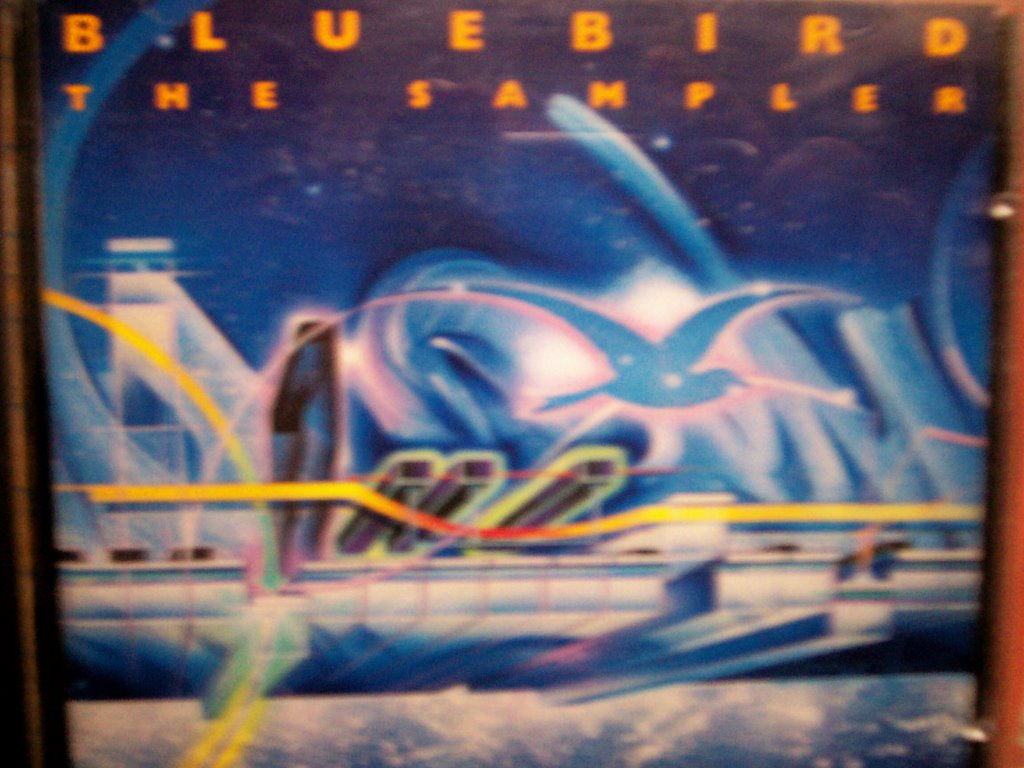
Here's a weird and wonderful mix – I found a Bluebird sampler yesterday that I bought a couple of years ago and promptly forgot about. Like all samplers, a curate's egg... But some interesting stuff. A rare Art Blakey Jazz Messengers track for starters – at the time when theoretically Jackie McLean had left and Johnny Griffin came in – except that they are both on this track, Bill Hardman making up the front line on trumpet – a peppy solo from him. McClean still plays under the heavy shadow of Bird here, Griffin his usual rapid-fire self. Sam Dockery on piano and the delightfully named 'Spanky' De Brest on bass. The guv'nor at the traps, majestically powering it all along.
The Mingus is an alternate take from 'New Tijuana Moods,' with the very wonderful and totally obscure Clarence Shaw on trumpet. A brief overview of the sessions that made up 'Tijuana Moods' and its later reprise with added alternate takes can be found here...
The Ellington band from 1967 make up this trio – Johnny Hodges on imperious form.
People seem to like Ornette – he's statistically the most popular download off this blog. So: here's a couple more from 'Change of the Century.'
Lastly – a repost of a couple of Derek Bailey tracks, solos from 'Improvisation'... why not? Just to mention a touching tribute (and free download of a track from the album featured here: 'Improvisation') to the late Derek from my friend and collaborator Murray Ward here... Another indication of the ways that Bailey touched many of us - apart from the music there was something about the man that generated deep affection among strangers...
Download
Art Blakey
Evans
Charles Mingus
Tijuana Gift Shop
Duke Ellington
Blood Count
Buy
Ornette Coleman
Download
Face of the Bass
Forerunner
buy
Derek Bailey
Download
M3
M9
Buy
Monday, January 02, 2006
Onwards... Louis Armstrong... Jimmy Guiffre... John Coltrane...

Haven't got round yet to the 2005 best of stuff – one has to observe the traditions, I suppose, but I've been concerned with other things - recovering from my night at the 'Pink Flamingo' on New Years Eve – and I also realised when I checked 'The Wire' best of year lists that I hadn't actually bought much this last twelve months that was directly new. The bebop posts are going on hold for a week or so as I'm trying to work on a longish Derek Bailey post - so here's some mp3s from the twenties to the sixties in no particular theming... a holding measure but also - just good music. The Louis Armstrong tracks sound as fresh now as they did when they exploded on the scene. I'm working backwards from the thirties – 'Swing that Music' to the Hot Five and Hot Seven stuff – just because I love the sheer happiness evoked in that first track (with a big band) – a great way to start the sequence. The other two tracks from the twenties – well, just listen and wonder...
The Guiffre Three – 'Train and the River' is the famous piece that was featured in 'Jazz on a Summer's Day' – so I added 'Crawdad Suite' as it's lesser known and just as good, I think, in a more languid, spacy manner. (And I've discovered some air shots of Guiffre with Paul Bley and Gary Peacock that I'll try to get round to converting from tape asap). Guiffre is one of those mavericks who still need an accurate reappraisal – from the Four Brothers Herman Herd to being ostracised in the sixties for playing free jazz – someone else I intend to write about soon... from Texas as Ornette was... something about that State and its players and the way that the blues is always lurking in their playing... which leads on to...
Coltrane playing the blues – self-explanatory: 'Blues to Bechet. Homage... to the other great soloist from New Orleans, the mercurial Sidney Bechet...
Maybe the link is the classic feel to all of these tracks - in the way that they look forward and backward at the same time. Sprung off the backbone of the blues and pivoting on Louis who more or less invented the role of bravura solo improvisor in the twenties – while retaining some gutbucket feel of New Orleans. We can see now that 'Jazz' is a continuum which confounds facile categorising...
Enjoy...
Download
Swing that music
buy
Potato Head Blues
West End Blues
buy
Jimmy Guiffre
Crawdad Suite
The train and the river
buy
or buy
Blues for Bechet
buy
Sunday, January 01, 2006
Happy new year...
Happy new year to all... Here's two longish (beware) tracks - Albert Ayler : 'Holy Holy.' A blast of the spirit to warm up a cold and slightly hungover New Years Day. Calvados for breakfast and ask no questions... And one last from Derek Bailey whose death cast a downer spell on the season– taken from when he was part of Tony Oxley's group that recorded 'Four Compositions for Sextet' in1970. British avant-garde at its best.
Download
Holy Holy
buy
Download
Saturnalia
buy
Thursday, December 29, 2005
Derek Bailey: Requiem 2
Two more tracks in my mini-tribute to the late Derek Bailey. 'Rocking Chair' and 'Stella by Starlight', both taken again from the 'Ballads' album...
Download
Rocking Chair
Stella by starlight
Buy
Download
Rocking Chair
Stella by starlight
Buy
Wednesday, December 28, 2005
Derek Bailey... Requiem...
I was rather hoping that it was either a hoax or a mistake – but even though the MSM don't seem to have picked up on Derek Bailey's tragic death yet - unfortunately it isn't. Here's a couple of tracks from Derek's 'Ballads' album: 'Body and Soul' and 'Georgia on my mind.' Opinion was divided somewhat when this came out - I thought it was fantastic...
Download
Body and soul
Georgia on my mind
Buy
Download
Body and soul
Georgia on my mind
Buy
Tuesday, December 27, 2005
Derek Bailey... 1/29/30 - 12/25/05... a personal appreciation...

Derek Bailey – An appreciation...
I never managed to get to a live Derek Bailey gig... which is a great hole in my aesthetic life. I had planned that in 2006 I was going to make an effort to go and see him somewhere – maybe in Barcelona where apparently he had made his home – or anywhere within geographical reason. Now – this will not happen. I first heard him on one of Charles Fox's radio three shows – 'Jazz Today' if I remember correctly, sometime back in the late 70's or very early 80's. Playing several solo pieces mainly on acoustic guitar. It was unlike anything I had ever heard – and by then I had been following the jazz avant garde for years. Maybe that was the point – that Derek (along with his cohorts in the sixties improv underground) went beyond 'jazz', 'white jazz', the tradition he came out of (passing throught the danceband and session years, the guitar vocabulary used in those areas very much rooted in the practice of jazz) and had essayed into the uncharted oceans of what he called in his superb book 'Improvisation etc' 'non-idiomatic improvisation.' As a guitar player, he had a profound effect on me and inspired my own fumbling attempts to free my playing up – I taped the show and somewhere have the old cassette – (if I can find it I'll copy it into mp3 format and put it out)– and listened to it over and over down the years.
Bailey was a formidable guitarist who, paradoxically, seems to have travelled back to the very ur-basics of music to explore the materiality of his instrument - wood and steel and the collisions of fingers and mind with these - and forwards at the same time, sending the notes spinning and skittering out into the world, conscious in the knowledge of what had gone before as he forged new sound spaces. I do not want to explore the technical side of his music too deeply here (maybe at a later date?) just to say that he was someone with wide ears and a conscious deep knowledge of the tradition – inside jazz and in the classical/serious world as well – hence the nuances of Webern, to clutch for a quick correlative.
There is a surface steely and difficult brilliance to his playing. (Maybe he was our English Cecil Taylor?) But give it the space it deserves and you can hear the depth of it: the technique certainly – whatever sounds he brought forth they were never fumbled or accidental in the execution but ring with the austere clarity of the sonorities of Thelonious Monk, say. The humour – unlike many on the avant-garde side and certainly the author of the recent book about him (a figure from the dead realms of Late Marxism it seems), he has something of the deadpan stand-up about him. The generosity - think of Company, the yearly festival he established to bring an amazing variety of players from many different disciplines together into a sprawling vibrancy in which he subsumed himself – famously saying on several occasions that he preferred playing with other musicians rather than solo – and a soloist supreme at that. Last of all – the essential integrity of the true questor. Uncompromising in days of extreme compromise musically and elsewhere and rescued from any sense of pomposity thereof and therein by the other qualities I have listed above – especially, maybe, humour. One section I remember from that old 'Jazz Today' radio shot was a 'suite' of interlinked pieces he called 'The only good jazz composer is a dead one.' Mordant and very funny.
RIP Derek Bailey...
Monday, December 26, 2005
Derek Bailey... RIP...

A first brief post to mourn the passing of the great avant-garde guitar player Derek Bailey – and to celebrate his work. Two tracks from the 1975 album: 'Improvisation.' Here's a great interview with Derek on Ubu Web. (This might not be working today as Ubu web have been having some problems). Another one from 1996 here...
More general information about his life and work here...
Download
M3
M9
Buy
Derek Bailey is dead...
Breaking news is that Derek Bailey, the great English improviser and guitar great has died. I discovered this via a regular surf over on 'Just for a day blog'a few minutes ago and will post more over the next few days when more information is available. A great loss and an amazing musician...
Thursday, December 22, 2005
When bop was young - part one...
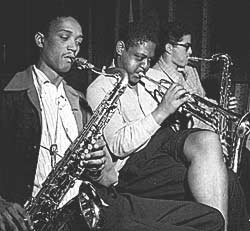
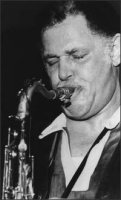
Bop was, of course, a quick hit – from the days of 78 rpm records and their inherent time restrictions. This helped to give it a compressed feel, a sprawling essence that had originally poured out on countless rehearsals, jams and all night sessions at places like Mintons – or in musicians' homes – to be taken into the studio and finely distilled into the record form of the time. I will start of this on-going sequence with some early stuff, two Dexter Gordon tracks, starting with one from 1944 with Nat Cole and Harry Edison. Dexter made the transition from swing to bop fairly quickly and easily – but these two early tracks show the 30's roots still preponderant – the second one is a fascinating mix between Buck Clayton and Bird with Dexter somewhere in the middle. Listening to this sequence, one should be able to detect the moves and jumps forward – some fluid evolution, some maybe more startling. Oo bop sh'bam... The rhythm sections show this especially – by the time Fats Navarro was recording these tracks, the drummers were playing the new rhythms essential to bop's flourishing. More asap...
Dexter Gordon:
download
I found a new baby (Los Angeles 1943: Harry Edison – Trumpet/Dexter Gordon – Tenor/Nat King Cole – Piano/Johnny Miller – Bass/Unknown – Drums).
If I had you (New York 1945: Buck Clayton – Trumpet/Charlie Parker – Alto/Dexter Gordon – Tenor/Sir Charles Thompson – piano/Danny Barker – guitar/Jimmy Butts – Bass/J.C. Heard – Drums).
Fats Navarro:
Our Delight (New York 1947: Fats Navarro – Trumpet/Ernie Henry – Alto/Charlie Rouse – Tenor/Tadd Dameron – Piano/Nelson Boyd – Bass/Shadow Wilson – Drums).
Nostalgia ( New York 1947: Fats Navarro – Trumpet/Charlie Rouse – Tenor/Tadd Dameron – Piano/Nelson Boyd – Bass/Art Blakey – Drums).
Lady Bird (New York 1948: Fats Navarro – Trumpet/Allen Eager, Wardell Gray – Tenors/Tadd Dameron – Piano/Curley Russell – Bass/Kenny Clarke – Drums/Chano Pozo – bjo?).
Dexter Gordon/Fats Navarro
The only place I have found all these tracks together is on a rather expensive set - but it's a massive collection, tending more to swing than bop but very good. (The collection I have is on an obscure label that I can't find a link for). These tracks can also be found fairly easily on Dexter and Fats (and Tadd Dameron) compilations of which there are legion... plenty of relatively cheap bebop retrospectives out there...
buy
Friday, December 16, 2005
Charles and Cecil...

Something for the approach of the festive season – and to keep things rolling while I work on my big bebop post. Two tracks – one by Charles Mingus and one by Cecil Taylor. The Mingus is from 'Oh Yeah.' Taylor's from 'Conquistador.' Although one of my favourite tenors plays on the Mingus album – the late great Booker Ervin, all the solos on this track are by Roland Kirk, summing the pork home in a fiery display backed by high-power rifferama from Jimmy Knepper's trombone and Ervin. Mingus is on piano and what might be loosely termed 'vocals' here and on other tracks (notably 'Devil Woman') leaving Doug Watkins to the bass chores and the ever-willing Danny Richmond on drums. Hog callin' indeed. My uncle's farmyard was never like this... From 1961.

Cecil Taylor produced two great albums round about the same time (1966) for Blue Note, 'Unit Structures' and the one I'm featuring here -'Conquistador.' Both are mighty statements - this track is an alternate take not on the original album – With(Exit). Interesting to note the different strategies of the soloists – Bill Dixon fragmentary, Jimmy Lyons by now having played regularly with Taylor, using his bebop-driven technique to string longer phrases across the roiling backdrop of Taylor, Henry Grimes and Alan Silva on basses and Andrew Cyrille on drums. For downloaders – note this is a long track – 17mb plus...
This is music of blood and fire - perfect for keeping warm on a cold December day a week before Christmas...
Download
Hog Calling Blues
Buy
Download
With(Exit) Alternate take
Buy
Thursday, December 15, 2005
Arthur and Ornette...

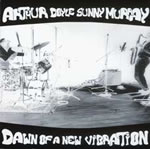
"I love being underground, man.” (Arthur Doyle).
The Arthur Doyle first (for an obscure programmatic reason that may become clearer by the end of this post...). This is Doyle with Sunny Murray recorded in Paris in 2000. Doyle re-appeared (one is almost attempted to say: from an earlier obscurity) over the last few years and is a 'character,' as it were... You can hear traces of what has gone before in his playing – but he has forged his own style – on flute as well as the tenor featured here with Murray's imperiously brilliant drumming. That 'character' speaks to people more than mere technique – there is something very idosyncratic about Doyle even in a business full of oddballs. Self-taught, he carries something of r and b and and black folkways into his work – similar to Ornette maybe, in that respect (and never forget Charlie Parker's immortalised days in the woodshed )– they both come from outside the straight jazz technical circle but Ornette has more strings to his bow (!) and is one of the dominant influences of 20th century music and beyond – like it or not. Doyle is more your second-line maverick – but still an engaging and interesting performer.
He comes in at the beginning with high register work, tentatively trying out broken phrases over the usual Murray rolling drums- those almost parade-ground figures. The line starts to extend over repeated phrases and is punctuated/polarised by high overblowing and gruff lower register work – Ben Webster with a sore throat crossed with some cross r and b sax. Some querulous notes – almost conversational – Doyle is a very 'vocalised' player. Given the fragmentary nature, the probing quality of the alto, it is left to Murray to establish the continuum of the piece – long rolling figures and splashing cymbals interspersed with sporadic thunderous bass drum work. Almost a stretched-out textbook version of bebop drumming in a curious way, as if the tight, jumpy complexities of Max and Klook et al were unrolled over a larger time-scale, freed up from the thirty two bar standard and the blues. Carrying the spatial image further - one wonders how programmatic the title 'Elephants Memories' is? The dreamy quality that ends the piece and the broken-up sax lines almost plodding across the hot savannah of the drums. Too fanciful? Maybe...
More Ornette – people seem to like his stuff more than any others I post so: here's two from a relatively obscure collection 'The Art of the Improvisers' which acts as a selection of refractions to the better-known Atlantic tracks of his early burst onto the scene. On 'Harlem's Manhattan' he also plays tenor and interestingly so. Refraction again... in a lower register it's Ornette at his best but sounding – well, deeper and different. Some wonderfully diamond-sharp drumming from Edward Blackwell – who I prefer behind him, to tell the truth. He seems to push more than Billy Higgins, good though he was. Thoughtful pocket trumpet from Don Cherry, a slow-building solo. Solid bass from Jimmy Garrison including a neat solo with some stopped guitar-like thrumming. But this is Ornette's track as he goes out on another solo that cleverly leads straight back into the unison head. One of the facets of that quartet's collective style that was so intriguing – the accuracy of the unison theme statements, delivered with bebop-like accuracy that could turn on a dime, so to speak – but moved along from bop into a different musical world.
Which brings us to 'The Legend of Bebop.' Back on alto and Charlie Haden in the bass chair. The theme contains elements of bop phrases – and earlier jazz, come to that, but beyond the head it's Ornette's world. The spatial qualities he brought to the music are on display here: his solo breathes easily at this loping tempo with some exquisite drumming from Blackwell and Haden sure and true on a walking line. Cherry delivers of another neat solo, prodded well by Blackwell. A strange theme – I had to track it back a couple of times to work out what was going on -basically, it's two twelve bar sections with a ten bar between them, an expanded blues.
Bebop blew the standard forms into further complexity, precursive to later freedoms such as Coleman's, as Parker and company ran speedily amok over the bar lines in their original themes (based usually on the blues and the 32 bar song form but under-pinned by much denser harmony) and solos. But still, at that time of forties revolution, encased by the standard forms, no matter that solos would asymetrically cross these delineations – in tandem with the drums. Which gives bop much of its tensions, after all: the turnaround is always going to come at a certain place in the line, however cunningly disguised by the piano, say, as main harmonic marker (or guitar), whatever linear teasings and stretchings the soloist is indulging in. (Although let us not forget Duke Ellington's unique compositional and performative areas that do not fit the conventional time line – there are other examples that I won't go into here, one being the playing of Art Tatum, but my argument stands up in general terms). Given the 78 rpm record that was standard up until the extended play format introduced in the fifties, one can maybe understand why there is a manic edge to many bop tracks, leaving aside any cultural/sociological explanations for the moment – everything is densely compressed to cram into the recording format and the song form. Live recordings of the time can sometimes seem less frenetic for obvious reasons of more space available – but that edge is usually still there. Possibly one way of looking at the subsequent new wave is as an overspilling (made possible on record by long players) into a new space opening up beyond the old structural. This had started fairly early on – look at Miles Davis and the 'Birth of the Cool' recordings alongside the 'cool school' so-called. But these manifestations were still from inside the camp, as it were. Leaving aside Lennie Tristano's free-form work – which never saw the light of day at the time, deemed too shocking to release (!). But all of these musicians were operating from within. Ornette came from outside... yet, despite – or because of – his self-taught status, he had a firm sense of what he was about and his place in the scheme of things. This track seems to reflect and musically document that historic move that he played a dominant part in - the cheeky title 'The Legend of...' implies that bebop existed further back in time that it actually did – Charlie Parker had only died in 1955, for example! The tune is (slyly?) boppish, albeit the odd construction noted above and Charlie Haden relies on straight walking bass as if in an echo of earler times when the bop fulcrum had shifted from bass drum to bass. But the piece is taken at a leisurely midtempo, oddly one may think in consideration of the trademark bop speediness – another ironic wave at that past freneticism?
Ornette's music always implicitly carried a sense of where it had come from as well as how far it had travelled. This can be measured in one sense by that jittery bebop quality found in his faster themes– that ends after the head as the solos plunge into a freer space, away from the perceived restrictions of the repeating chorus and harmonies. As if saying – 'Yes, I can play the old way – now listen to my new way.' The tumultuous logics of bop had after all contained much of what had gone before - much more than was realised at the time when they were similarly seen as an outrageous travesty by many critics. Looking back now at an admittedly subjective timeline that reaches from the Hot Five, say, to Bird and Diz to Ornette, or New Orleans frontline to Albert Ayler – a period of just over thirty years – it is easier to perceive the ongoing connections. A subject I hope to deal with in more detail soon – look out for 'When Bop was young!'
Arthur Doyle and Sunny Murray
Upload
Elephant's Memories 3
or
Buy
Ornette Coleman:
Upload
Harlem's Manhattan
The Legend of Bebop
Buy
Wednesday, December 07, 2005
Three by Ornette...

Prime Time Ornette...
Success... at last I have managed to upload these files, three from Ornette Coleman and his Prime Time group, taken from the album 'Tone Dialling.'
'Enter Tone Dialing, a sound experience of music in the present perception of society as it becomes an ethical civilization of all world citizens.' (Ornette Coleman, taken from the liner notes to 'Tone Dialling').
'Street Blues' starts with a funky electric guitar riff leading into Ornette floating over a back-beated, sprawling unfolding – tablas, bass, guitars. It's one of those tracks that repays repeated listenings as this music is very layered - from the drums upwards to the bass, guitars and Ornette flying over it all. When I saw him earlier this year one particular facet of his playing struck me – the manner in which he will drift slow bending phrases across a usually busy backdrop – then suddenly lock in rhythmically in a faster unison – echoes of the rapid fire hyperbebop themes he was writing way back when.
'Kathelin Gray' starts with slow, elegaic piano – of all things – not an instrument he ever featured much and indeed seemed to want to escape the verticality of - re Gerry Mulligan almost (although let us not forget that he recorded initially with Paul Bley and has used piano more recently in collaborations with Joachim Kuhn). Half of the track is out of tempo piano, supported by minimal pattering percussion until Ornette comes in and states the theme again and the musicians criss-cross behind him – a glimpse maybe of what harmolodics really means -the independence of the individual lines that create an expanded space where somehow they all resolve.
'Family Reunion' – guitar riff over busy percussion straight in – some almost unison lines and more jazzy drums than on 'Street Blues' – less straight backbeat and more rolling interspersions from Denardo coupled with a heavier cymbal presence – some smashing crash cymbal work here. The individual lines all stretch out across the mix as Ornette seems to be sharing equal sonic space, just relying on the cutting timbre of the alto to lift above the band. Towards the end, after a brief theme re-statement, some of the musicians drop out to leave Ornette soloing over some deep, swooshing bass, drums and tabla – to end abruptly.
There is a generosity in Ornette's music – the democracy of instruments he invokes and the space they have to create in. Prime Time is the electronic arm of his kingdom -the one less enjoyed by the conventional jazz critics, still ever suspicious of electricity, and is unique in sound and development. I have an odd theory that goes back to Texas music in general (Ornette is from Fort Worth). A border state indeed – where different traditions rub up against each other – and a long-standing blues tradition – exemplified by Blind Lemon Jefferson, a consummate player who could reel off riff after riff in a free-wheeling manner that ran all over the conventions of the 12 bar blues but surely in an inherently knowing way given the exemplary technique involved – maybe I'll put some of his stuff up soon. And later on, Lightnin' Hopkins, a more limited technician maybe but one who had a sure sense of his rhythms and music. Ornette comes out of that same deep blues tradition and surely this is a stream that flows into his free jazz innovations – the avant garde was always rooted more firmly in the tradition than was realised at the time. Self-taught on all his instruments, a true self-made pioneer who has the wide open spaces of Texas blowing through his music – and I also hear the vertical take in the Prime Time band that stacks up different levels of sound and genre creating an expanded hybrid that reaches out beyond jazz. Oddly enough, when I was listening to Bob Wills and the Texas Playboys years ago it came to me – the similarity. In Wills' music, you have the hee-haw vocals, the weeping wailing country hoedown of the fiddles, some almost-bebop electric guitar licks (and remember that the first revolutionary on electric guitar in jazz was Charlie Christian, another Texan), over the piano and rock solid rhythm section. They called it 'Western Swing' – an organic meld of the various popular musics of the time.
Listening to Prime Time I hear that same space and verticality – similar maybe to Miles' electric incarnations from Bitches Brew onwards in that they both tried to take on the 'Electronic Sublime' of popular music. (And replete in the irony of Miles calling Ornette 'psychotic' when you consider the trumpeter's difficult personality and behaviour - often fuelled by drugs -and the harder road Ornette travelled from Fort Worth while retaining an essential gentleness). But in Miles you hear drums, yes, and a sprawling, smudgy middle at times overlaid with his trumpet at the head. Ornette, for all his claims to democracy, is similarly the lead voice most of the time. But underneath the lines split and shimmer away, sometimes admittedly densely laying in blocks but usually having more individually defined linear movement – harmolodic, anyone?
'Tone Dialling' as a whole bears out my Bob Wills metaphor in its complex layering, coming off the quote I opened with– some kind of global manifesto about the state of music in 1995 and Ornette's willingness to let it all flow through – on other tracks he moves from Bach to funk to rap to good old free jazz and Eastern timbres. Let it all hang in or something...
Download
Streetbluesmp3
Download
Kathelin Graymp3
Download
Family Reunionmp3
Buy
Thursday, December 01, 2005
Screwups...
I have been busy these last few days but intended to put up three Ornette Coleman and Prime Time tracks nevertheless. Unfortunately, having problems with the uploading... will attempt to rectify... also have the next episode in the ongoing saga of the dear old club sporadic on Saturday upcoming and will be rehearsing and playing all day... busy busy...
Tuesday, November 22, 2005
Jazz, rock, funk – take your pick... three from Elton Dean, Miles Davis and Brian Auger/Julie Tippett...
Apologies, amigos... I've been doing other things, went to Dublin last week and got wrecked when I came back so was out of action... But onwards...
This week I'm going electric: three disparate tracks from jazz musicians who have used electronic instruments and embraced elements of rock and funk. One would havethought that the Miles Davis track from 'On the Corner' would have been the first recording of this sequence, given his pioneering embrace of technology and being regarded as the fountainhead of jazz-rock from 'Bitches Brew' onwards. But Auger recorded the album 'Streetnoise' a couple of years before – and there was an interesting scenario playing out in the UK during the sixties with the overlapping and mixing of styles between jazz, blues, R and B etc. Blues/R and B being the catalyst and the area where all of it came together. I'm thinking of bands like Alexis Corner's Blues Incorporated and the Graham Bond Organisation – both of whom I saw several times in the mid-sixties. Korner – singer and so-so guitar player used to bolster his group with the best jazzers available when he went out on the road. Graham Bond had been a fiery jazz alto sax player, winner of Young Jazz musician of the year when he was with Don Rendell's group (saw them as well – they were great!). Then as the Beat Boom and the R and B boom rolled on, he formed a band with jazzers Ginger Baker, Jack Bruce and Dick Heckstall-Smith – (someone else who saw no boundaries in music as opposed to many other modern jazz musicians then and now) – and featured himself on vocals, electric organ and sax – often playing sax and organ at the same time. A fat wild man in a kaftan, a far cry from the bebop cool and lounge suits of his previous incarnation. Performing a lot of Chicago Blues overlaid with gritty chunks of hard bop, the organ sound of Jimmy Smith and Jack Mc Duff et al transported well into these set ups. And the lineage was there to be found – organ and tenor groups in jazz had been around for a while where the edges between R and B and jazz were blurred – especially in the hard bop/soul jazz camp coming out of the Jazz Messengers as prime example – blowing hard on Bobby Timmons tunes. Not to forget Cannonball Adderley – who had established his credentials and played on one of the the sublimely definitive jazz recordings – 'Kind of Blue.' With Miles... Much of this history is intricately interlinked and I have no time to unravel it all here. Just to note that Joe Zahwinul came out of Miles' lineups and also played in the Adderley Brothers band and wrote 'Mercy Mercy Mercy'- which was to figure large in the repertoire of British r and b'ers who did the crossover ride (he of course went on to found 'Weather Report'), along with 'Work Song,' 'Moanin'' from the Blakey book – a Timmons tune that was a big juke box hit. R and B and jazz had never been far from each other in the States – when they came together in the UK and before 'fusion' became the great bland out some interesting sparks were struck.
Here's an interesting site about Graham Bond
which has a lot of archive reviews giving a flavour of the times.
Brian Auger paralleled Graham Bond. From Young Jazz Musician of the Year on piano to electronic outcast on organ who saw way beyond the ghetto that modern jazz could frequently become... He eventually re-located to the US where he figured that his eclecticism would be better appreciated. The two tracks here are from 'Streetnoise' – the last recordings with Julie Driscoll until a brief reunion in 1977, I think. 'Light my Fire' is a waltzy take on the tune made famous by Jose Feliciano and The Doors and shows off Auger's bluesy organ style. I don't think Driscoll has ever made a bad record – her majestic voice slow burnsthroughout - to my ear bearing resonances of Nina Simone and a distant edge of Sarah Vaughan – jazz and soul credentials intact but nevertheless her own woman. A unique talent - who married the great pianist Keith Tippet and left the pop world for the wilder and more remote shores of experimental/improvised music – where she still remains. 'All blues' is the Mile's tune with Oscar Brown Jr's lyrics - which are secondary to the vocal timbre and finesse with which she negotiates the track, accompanied by Auger on piano, displaying his mastery of the bluesier side of jazz out of Bobby Timmons or Les McCann, say - those rolling, gospelly licks. These two songs are actually more jazzy than some of the others on the album which combines jazz, blues, and folk even (great Godamighty! Donovan covers and more!) - and pulls it off without compromising any of the ingrediental musics.
Download
All Bluesmp3
Light my firemp3
Buy
Go forward a couple of years and 'On the Corner' arrives – Miles trying to kill off the jazz critical establishment with a hearty dose of apoplexy. This album was universally hated by the jazz critical mafia and is a neglected masterpiece – as much for what it foreshadowed. I've chosen the daftest track – 'Mr Freedom X' which is a melange of what sounds like african percussion, indian tablas, electric bass, an electric sitar? - electric keyboards, and some randomish synthy-noise, slowly starting to build into a messy but infectious groove as the trap drums lock in. Add a few smears of Carlos Garnett's sax – whaddayagot? Jazz? Possibly not, Cyril... yet it comes from jazz even if it ends up in a sound world that prefigures trip-hop and other recent electronic boogies. It also sounds as if it was put together in the studio – Mile's and Teo Macero's african/jazz mixtrack and another heretical move. But when you figure that not long before this guy was still playing expanded bebop – you have to admire Miles' exquisite risk-taking – and his superior strategies in electronic ladyland – compared to the bland mess that fusion/jazz-rock was to become in the main (and that includes much of 'Weather Report' as well...).
download
Mister Freedom xmp3
Buy
The Elton Dean track is the most recent recording display here. A trio performance with Dean on electric keyboard and sax – shades of Graham Bond. Well, maybe not – this is much more jazzy – the most 'jazz' track out of all of these – and I can't quite see Elton Dean belting out 'Got my Mojo Working.' This is a dense sound with the electric organ underneath and the drums avoiding the more groove-orientated paths. Yet you can place it in the same lineage – coming out of both jazz and r and b – albeit the free-jazz side of things. And with a hefty reminder for me of the sprawling electronic improvised grooves that Miles initiated on 'Bitches Brew' and was to use as the seed-corn of 'On the Corner' among others – taken away and edited/spliced into new configurations. Here, this is a studio improvisation that doesn't sound overtly edited and has a cleaner sound despite the timbral thickness – only three instruments and the Fender Rhodes doesn't clash with the Hammond organ. But I can imagine this as a stripped-down echo of those Miles sessions with maybe a small homage to the sixties UK scene?
Good article about E Dean here...
download
New Roadsmp3
Buy
This week I'm going electric: three disparate tracks from jazz musicians who have used electronic instruments and embraced elements of rock and funk. One would havethought that the Miles Davis track from 'On the Corner' would have been the first recording of this sequence, given his pioneering embrace of technology and being regarded as the fountainhead of jazz-rock from 'Bitches Brew' onwards. But Auger recorded the album 'Streetnoise' a couple of years before – and there was an interesting scenario playing out in the UK during the sixties with the overlapping and mixing of styles between jazz, blues, R and B etc. Blues/R and B being the catalyst and the area where all of it came together. I'm thinking of bands like Alexis Corner's Blues Incorporated and the Graham Bond Organisation – both of whom I saw several times in the mid-sixties. Korner – singer and so-so guitar player used to bolster his group with the best jazzers available when he went out on the road. Graham Bond had been a fiery jazz alto sax player, winner of Young Jazz musician of the year when he was with Don Rendell's group (saw them as well – they were great!). Then as the Beat Boom and the R and B boom rolled on, he formed a band with jazzers Ginger Baker, Jack Bruce and Dick Heckstall-Smith – (someone else who saw no boundaries in music as opposed to many other modern jazz musicians then and now) – and featured himself on vocals, electric organ and sax – often playing sax and organ at the same time. A fat wild man in a kaftan, a far cry from the bebop cool and lounge suits of his previous incarnation. Performing a lot of Chicago Blues overlaid with gritty chunks of hard bop, the organ sound of Jimmy Smith and Jack Mc Duff et al transported well into these set ups. And the lineage was there to be found – organ and tenor groups in jazz had been around for a while where the edges between R and B and jazz were blurred – especially in the hard bop/soul jazz camp coming out of the Jazz Messengers as prime example – blowing hard on Bobby Timmons tunes. Not to forget Cannonball Adderley – who had established his credentials and played on one of the the sublimely definitive jazz recordings – 'Kind of Blue.' With Miles... Much of this history is intricately interlinked and I have no time to unravel it all here. Just to note that Joe Zahwinul came out of Miles' lineups and also played in the Adderley Brothers band and wrote 'Mercy Mercy Mercy'- which was to figure large in the repertoire of British r and b'ers who did the crossover ride (he of course went on to found 'Weather Report'), along with 'Work Song,' 'Moanin'' from the Blakey book – a Timmons tune that was a big juke box hit. R and B and jazz had never been far from each other in the States – when they came together in the UK and before 'fusion' became the great bland out some interesting sparks were struck.
Here's an interesting site about Graham Bond
which has a lot of archive reviews giving a flavour of the times.
Brian Auger paralleled Graham Bond. From Young Jazz Musician of the Year on piano to electronic outcast on organ who saw way beyond the ghetto that modern jazz could frequently become... He eventually re-located to the US where he figured that his eclecticism would be better appreciated. The two tracks here are from 'Streetnoise' – the last recordings with Julie Driscoll until a brief reunion in 1977, I think. 'Light my Fire' is a waltzy take on the tune made famous by Jose Feliciano and The Doors and shows off Auger's bluesy organ style. I don't think Driscoll has ever made a bad record – her majestic voice slow burnsthroughout - to my ear bearing resonances of Nina Simone and a distant edge of Sarah Vaughan – jazz and soul credentials intact but nevertheless her own woman. A unique talent - who married the great pianist Keith Tippet and left the pop world for the wilder and more remote shores of experimental/improvised music – where she still remains. 'All blues' is the Mile's tune with Oscar Brown Jr's lyrics - which are secondary to the vocal timbre and finesse with which she negotiates the track, accompanied by Auger on piano, displaying his mastery of the bluesier side of jazz out of Bobby Timmons or Les McCann, say - those rolling, gospelly licks. These two songs are actually more jazzy than some of the others on the album which combines jazz, blues, and folk even (great Godamighty! Donovan covers and more!) - and pulls it off without compromising any of the ingrediental musics.
Download
All Bluesmp3
Light my firemp3
Buy
Go forward a couple of years and 'On the Corner' arrives – Miles trying to kill off the jazz critical establishment with a hearty dose of apoplexy. This album was universally hated by the jazz critical mafia and is a neglected masterpiece – as much for what it foreshadowed. I've chosen the daftest track – 'Mr Freedom X' which is a melange of what sounds like african percussion, indian tablas, electric bass, an electric sitar? - electric keyboards, and some randomish synthy-noise, slowly starting to build into a messy but infectious groove as the trap drums lock in. Add a few smears of Carlos Garnett's sax – whaddayagot? Jazz? Possibly not, Cyril... yet it comes from jazz even if it ends up in a sound world that prefigures trip-hop and other recent electronic boogies. It also sounds as if it was put together in the studio – Mile's and Teo Macero's african/jazz mixtrack and another heretical move. But when you figure that not long before this guy was still playing expanded bebop – you have to admire Miles' exquisite risk-taking – and his superior strategies in electronic ladyland – compared to the bland mess that fusion/jazz-rock was to become in the main (and that includes much of 'Weather Report' as well...).
download
Mister Freedom xmp3
Buy
The Elton Dean track is the most recent recording display here. A trio performance with Dean on electric keyboard and sax – shades of Graham Bond. Well, maybe not – this is much more jazzy – the most 'jazz' track out of all of these – and I can't quite see Elton Dean belting out 'Got my Mojo Working.' This is a dense sound with the electric organ underneath and the drums avoiding the more groove-orientated paths. Yet you can place it in the same lineage – coming out of both jazz and r and b – albeit the free-jazz side of things. And with a hefty reminder for me of the sprawling electronic improvised grooves that Miles initiated on 'Bitches Brew' and was to use as the seed-corn of 'On the Corner' among others – taken away and edited/spliced into new configurations. Here, this is a studio improvisation that doesn't sound overtly edited and has a cleaner sound despite the timbral thickness – only three instruments and the Fender Rhodes doesn't clash with the Hammond organ. But I can imagine this as a stripped-down echo of those Miles sessions with maybe a small homage to the sixties UK scene?
Good article about E Dean here...
download
New Roadsmp3
Buy
Thursday, November 10, 2005
Message from Whitedog...
The jazz posts are a little behind this week - but look forward to three forays into electricity. In the meantime, DJ Whitedog, the enigmatic house DJ at the Club Sporadic plays a mix of criss-crossing/hard bopping/genre crossing/blueslooping/ traxs for your edification and enjoyment (it says here...). Grab an experimental new mix - cantos 1 - here - this is a BIG file - 29 MB.
Thursday, November 03, 2005
Trios...

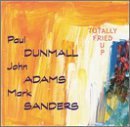
This week I picked out two trios at random, one English, one American. The English trio (and duo) are much more collective affairs, surprisingly maybe, given Paul Dunmall's strengths as a soloist. Both trios have also dispensed with bass. Compare and contrast, as they say...
The English group, fetched up on the independent label that George Haslam runs: Slam, consists of Paul Dunmall, John Adams and Mark Sanders on tenor, electric guitar and drums respectively, who recorded the cd 'All Fried Up' in March 1998. I've given two tracks, a short one by the trio and a longer one by Dunmall and Adams without the drummer. There is the odd taste of Coltrane in the saxophonist's playing, which is probably unavoidable, coming out of the tradition and also playing in Alice Coltrane's band when he was resident in the US for three years – but Dunmall has his own firm stamp, has developed his style over the years to fit the diverse contexts he plays in and still remain his own man. (Alan Skidmore, say, would be your candidate for full-throttle Coltraneing in a Coltrane tribute band - a bit unfair, maybe... come to think of it, they played together in a two hard tenor group back in the eighties if I remember correctly...). Dunmall has honed his playing into an individual, free blowing style and can be heard in many different line-ups – he has also recorded a large amount of material most of which is still
available –
here's a good selection that demonstrates his musical fecundity...
He is also a player I have admired since he made his bones in a long tenure with 'Spirit Level' way back, right through to his later incarnations with the likes of Keith Tippett, the London Jazz Composers Orchestra - and not to forget the bagpipe explorations...
'Totally Fired Up' starts with Dunmall in frenetic, hard-squalling mode – a literal echo of the title? - underpinned by choppy chords from the guitar and Sanders' sure-footed drums – this is a democracy of horn, guitar and drums, equally sonically balanced, that ends abruptly on a couple of deep, blatted tenor notes.
The second track, a duo: 'Captured a Rapture'. They start slowly – Dunmall plays long notes low down and ruminative as Adams starts to build a framework eventually picking a faster lattice work of notes round him, progressing to swift chording alternating with single note runs – an abstraction of traditional 'comping.' Dunmall speeds up – yet Adams matches him as they build longer lines that cross and inflect, parallel and veer. Two instruments and no rhythm section – yet there are not many gaps – a very full sound world invoked here. Dunmall goes into the higher register as the track progresses and the lines combine and contrast to end almost abruptly again on a bunch of ascending chords.
The Americans: Jimmy Lyons leading his partner Karen Borca on oboe and drummer Paul Murphy on a track from the recent retrospective 5 cd set on the Ayler label.
Jimmy Lyons was known much more for his long tenure with Cecil Taylor than for being a leader – yet the release of the boxed set that this track comes from demonstrates many other facets of his work, outside the wild and wooly world of Cecil. "Jump Up" was recorded in Geneva in May 1984 with bassoonist Karen Borca and drummer Paul Murphy and could almost be an Ornette Coleman tune or a speeded up Albert Ayler number, briefly stated by the alto and bassoon before Lyons launches into a fast, fluid boppy solo over the busy drums- the long rat-tatting snare patterns of which remind me of Sunny Murray. One thing you notice very quickly is his ability to articulate accurately even very short note durations at speed. If he smears a note – it is intentional emotional colouring rather than a slip of the embouchure and fingers. This is Charlie Parker taken into the dimensions of 'free jazz' – some hint of what might have been if the Bird had lived? One wonders... Lyons came strongly out of Bird but by this time had long established himself as a master saxophonist, an underrated one due to his years with Taylor no doubt – yet Cecil had a great deal of respect for the man, regarding him as his 'right arm' during their long and fruitful association up to Lyons' tragic death in 1986. And Taylor's band must have a been a hard school to survive in – it is to Lyon's credit that he developed such successful saxophone strategies to play against the sheer density and speed of the pianist's sound world. These were in place early on... If you listen to the sessions recorded at the Cafe Monmartre the shadow of Bird is still very strong – but Lyons more than holds his own. Contrast Archie Shepp when he recorded with Taylor – he sounds uneasy and floundering.
Karen Borca complements the alto player well, plays a longer solo, long fluid lines, a deeper sound, coming close at times to resembling a baritone sax. The drummer plays back a bit behind her, in contrast to his busy work behind Lyons. The drum solo is interesting in that it continues the rhythmic feel of the track – long, fast almost smooth lines – a very linear approach compared to Taylor's music. Marsh is rolling long patterns on toms and snare that reflect the horns playing. This particular trio is also contrasted to the Dunmall et al track by its emphasis on solo work – almost a traditional conception of brief head, solos then reprise the head. Bop taken on further by different means? A conscious homage? I figure that Lyons's solos are not so different in his work outside Taylor's group from those he played with the pianist - give or take a few contextual re-adjustments - which says a lot about the metalanguage of the saxophone that he developed so successfully. And the speed of thought melded to ferocious technique necessary to be comfortable in both worlds. Lyons' work repays much study and the Ayler cd set is a belated tribute to an undersung master.
Two different trios, then, led by underrated musicians, one dead, the other still going and blowing strong. Check out the bagpipes sometime (I kid you not - brilliant!)
Paul Dunmall Trio:
download – all fried upmp3 -
download- capture a rapturemp3
buy
Jimmy Lyons Trio
download - jump upmp3
buy
Wednesday, November 02, 2005
Club Sporadic - Saturday 22 October - Black Carrot...
The travails of a club curator... (hey, I love that phrase: club curator... rolls off the tongue...) Maybe this game is some kind of addiction – lying in bed at 5 pm Saturday afternoon when you have to be up and doing very soon and you just want to sleep because you had 4 hours the night before and you know that there is no way out: a club curator has to do the gig, whatever... Especially when you are performing as well, opening the show with one person whom you know well as a player – but the other you don't and you get that feeling: am I able to acquit myself well enough given exhaustion etc and this guy is supposed to be good and... in the event it's the old addiction kicking in: the club jones, the muso jones – the improv jones where you have nothing to fall back on if you play honestly – and the best part of the addiction is exactly that you have to play honestly and as fresh as possible to get the hit. And you need the hit – and you get the jolt – when you can sit back finally at 00.23 am which is relatively early for apres-gig back in your own sweet hovel with a can of Budweiser cold out of the fridge. Time to reflect on – well, what made the night so damn good? Apart from meeting and playing with a new musician – Michael – who had to rush off to Leeds but made a significant impression on me and those who heard him play with myself and David Teledu (whom God preserve!). I met and heard a new band to me: Black Carrot from Market Harborough – brothers in the game of provincial music making of the free and improvised and experimental variety. Second gig I've been at this week (third if you count my bizarre encounter with the Basford Variety Club which I still haven't written up – I need a quiet day dedicated to deciphering the records - scraps of paper, scribbles on beer mats - the usual - which has not turned up yet). And as good in a small east midlands club as the Jandek gig in the big city was: a tight, punchy band who play mainly improvised sets and songs. Black Carrot... You can guess by now that I liked them...
Plexus in its incarnation of myself and David Teledu plus guest Michael Canning opened the show and had decided to play as a unit rather than split up into various line-ups – due to time as much as anything else – and space: the Sporadic is a small club and there was a lot of equipment scattered around. We marshalled guitars, bass, synths, laptop and borrowed drums at the end to perform two pieces, one by David, the other by myself. Loose sketches, giving a basic tonality (C and G respectively) for each piece and suggestions on how to move through together. (I have received a cd recording of the set from David subsequently and played it back once – to me it sounds very good, but reviewing your own music is somewhat fraught with danger! I'll leave it at this – ) Michael Canning added some wonderful touches to our improvisation, at the end moving onto drums to give added rhythmic colour. David was prolific, switching instruments and colorations and I mainly thumped away at the lap top although I moved onto guitar at one point when the drums started as I felt the laptop could not respond quickly enough to what I wanted to add to the rhythms.
Black Carrot are a three piece, drums, acoustic bass and keyboards doubling (trebling?) sax, bass recorder (I think) and electric guitar. They started with arco bass and electric keyboard – low sounds and high ringing clusters. The bass went into a pizzicato keening, singing section and the drummer edged in on cymbals – a jazzy 4/4 ching-ching-ker-ching type rhythm with bluesy keyboard. Then vocals added – a loose duet between the bass and keyboard player – words blurred and bent to be fairly incomprehensible (buy their cd – some of the same tracks are on it and you can find the lyrics written here as well!). A unique sound, I think - I have heard them compared to Morphine but personally don't hear it... the acoustic bass gives them a jazzier feel, for a start and Morphine are a bit one-dimensional whereas Black C have several strings to their various bows. They play long stretched-out numbers (like us) which gives plenty of space for improvising. I am a fan of long songs live or otherwise as I'm always curious on what journey I'm going to be taken on – this was a very interesting ride and one that I would like to experience again...
Further numbers brought in sax – punchy, free-jazzish, using what sounded like pedal effects at times to double the line – and the (probable) bass recorder and electric guitar - I had to go and get a drink (well, it had been a long day for little me...)so missed some of this last but came back to hear e-bowed guitar – long, sad singing notes which added another dimension to their varied sound world. A crisp and sharp unit, dedicated to the virtues of improvisation and also incredibly nice people. Hard actually to categorise them easily – which is to the good. This is music that has the rigour of improvisation done well but also is accessible via the jazzy rhythms (at times they reminded me of a New York-style band like Defunct or James Chance and the Contortions, maybe, from the punk jazz/loft side of the no-wave days).
There are things stirring out in the provincial undergrowth beyond the capital city... Loughborough... Market Harborough... tomorrow the world...
You can buy their cd: 'Cluk' – here -
Plexus in its incarnation of myself and David Teledu plus guest Michael Canning opened the show and had decided to play as a unit rather than split up into various line-ups – due to time as much as anything else – and space: the Sporadic is a small club and there was a lot of equipment scattered around. We marshalled guitars, bass, synths, laptop and borrowed drums at the end to perform two pieces, one by David, the other by myself. Loose sketches, giving a basic tonality (C and G respectively) for each piece and suggestions on how to move through together. (I have received a cd recording of the set from David subsequently and played it back once – to me it sounds very good, but reviewing your own music is somewhat fraught with danger! I'll leave it at this – ) Michael Canning added some wonderful touches to our improvisation, at the end moving onto drums to give added rhythmic colour. David was prolific, switching instruments and colorations and I mainly thumped away at the lap top although I moved onto guitar at one point when the drums started as I felt the laptop could not respond quickly enough to what I wanted to add to the rhythms.
Black Carrot are a three piece, drums, acoustic bass and keyboards doubling (trebling?) sax, bass recorder (I think) and electric guitar. They started with arco bass and electric keyboard – low sounds and high ringing clusters. The bass went into a pizzicato keening, singing section and the drummer edged in on cymbals – a jazzy 4/4 ching-ching-ker-ching type rhythm with bluesy keyboard. Then vocals added – a loose duet between the bass and keyboard player – words blurred and bent to be fairly incomprehensible (buy their cd – some of the same tracks are on it and you can find the lyrics written here as well!). A unique sound, I think - I have heard them compared to Morphine but personally don't hear it... the acoustic bass gives them a jazzier feel, for a start and Morphine are a bit one-dimensional whereas Black C have several strings to their various bows. They play long stretched-out numbers (like us) which gives plenty of space for improvising. I am a fan of long songs live or otherwise as I'm always curious on what journey I'm going to be taken on – this was a very interesting ride and one that I would like to experience again...
Further numbers brought in sax – punchy, free-jazzish, using what sounded like pedal effects at times to double the line – and the (probable) bass recorder and electric guitar - I had to go and get a drink (well, it had been a long day for little me...)so missed some of this last but came back to hear e-bowed guitar – long, sad singing notes which added another dimension to their varied sound world. A crisp and sharp unit, dedicated to the virtues of improvisation and also incredibly nice people. Hard actually to categorise them easily – which is to the good. This is music that has the rigour of improvisation done well but also is accessible via the jazzy rhythms (at times they reminded me of a New York-style band like Defunct or James Chance and the Contortions, maybe, from the punk jazz/loft side of the no-wave days).
There are things stirring out in the provincial undergrowth beyond the capital city... Loughborough... Market Harborough... tomorrow the world...
You can buy their cd: 'Cluk' – here -
Wednesday, October 26, 2005
Oliver and Albert...
This time round: two sax players. Albert Ayler is one of the sixties firebrands who probably is still one of the last to be understood comprehensively and whose legacy is yet to be satisfactorily defined – aided by the fact he died young in tragic circumstances, with so many disparate musical threads left dangling. Oliver Nelson went on to become a well-respected composer/arranger, but his initial recordings were made with Eric Dolphy whose explorations splintered the walls of jazz harmony without bursting through totally into free-form freakout – but who also died tragically young – again, prompting speculation of what might have been... Dolphy is also present on the, undisputed I would say, masterpiece that Nelson recorded in 1961: 'The Blues and the Abstract Truth.' A stellar lineup – Roy Haynes on drums, Bill Evans on piano, bass chair taken by Paul Chambers, George Barrow as sideman on baritone – Dolphy on flute and alto. And Nelson on tenor and alto. Every track on this album has something special about it: the one I have selected is one of the most beautiful compositions in jazz: 'Stolen Moments.' An extension of the 12 bar blues in C minor, this is a 16 bar theme with solos over 12 bar choruses. Nelson says in the sleeve notes to the original album that he wanted to 'let the musical ideas determine the form and shape of a musical composition.' This is a young composer and player who is looking to extend the range and scope of jazz right on the cusp of the upheavals that occurred in the sixties. Working from within the tradition but looking outwards, he had already made a couple of albums with Dolphy in tandem. Who was technically far ahead of Nelson. But Nelson had his own game and here he plays a rather mournful/wistful solo based on a fairly slow, simple idea which he drapes across the tight rhythm and cleverly builds as he contrasts the lower register and the higher and almost steals the show from the more accomplished musicians: Evans – at his rippling, meditative best - and the usual double-timed flamboyance of Hubbard and Dolphy on flute (who, to my ear,sounds almost Coltrane/sheets of sound-like in his solo, rather than the more angular cubist intervallic line he usually develops. Or maybe the timbre of the flute smooths out the usual Dolphey-esque kinks and jags?) Nelson also has a distinctive tone on his two horns – a wide vibrato that neatly reminds me of Albert Ayler, who had a vibrato on tenor that Joshua could have used to good and destructive effect in front of the walls of Jericho. (And the more obscure Ernie Henry who played with Monk on a couple of sessions). Solos aside, the magnificent melody is understrapped by a great arrangement – note the way the insistent trumpet phrase towards the end of the chorus is punctuated by the ensemble horns building and subsiding and the repeated phrase finally switching to sax. This is composer's jazz of the highest order and, I would suggest, a neglected masterpiece.
Ayler weighs in with the heavyweight free jazz rhythm crew of Henry Grimes and Sunny Murray, accompanied by Norman Howard on trumpet. 'Spirits' is one of those simple Ayler tunes that seem to have an almost calypso-ish flavour to them. One almost perfunctory chorus – then straight into the blowing. Ayler was a master of the higher range of the sax and I feel that this is what got in the way of a lot of original listeners who just could not hear what he was doing – that, and his taking the music back at times to some kind of Ur-jazz that hints at New Orleans polyphony and street marches, an emphasis on folkier roots that was far away from the slickness of bebop. Murray is super-speed rat-tat-tatting on snare (that abstracted march ambiance?) crossing this with rapid, zipping cymbal work. His conception of the new rhythms necessary to the performance of the music is fully in place by now and gives the track a jittering, speedy propulsion. Grimes is steady as you go and also contributes a nifty solo which demonstrates that he had his own take on how the bass fitted into the new music. The form is: scrabbled theme statement, some tenor/trumpet polyphony that quickly leads into an assured Ayler solo, using the full range of the horn from blatting low to squalling high – almost a fast historical synthesis/recapitulation of the way the tenor had been used in black music – the fleet runs carrying on the bebop heritage but now extended and smeared into a new expression, r and b squarks, and that big individualised tone, the individualisation of instrumental timbres being a folk technique (inherent in both european and african traditions) that was brought into twentieth century music via jazz in strict contrast to the formalised 'straight' tones of the classical tradition as known. Ayler, on his second record date, already has his trademarks in place, had obviously worked out where he wanted to go. And had just come back from Europe not long before where he had played with Cecil Taylor, interestingly enough. That vibrato of his, though not so pronounced here as it could be at times, has just reminded me of a violin and it has been suggested that he had some influence on Ornette Coleman's development of the trumpet and violin – areas of his playing that still cause controversy. (Although when I saw Ornette a while back, his violin playing was great, I thought, and fitted perfectly into his musical conception, especially playing off the two bass players in the group). Howard solos in turn, fast flurries, admittedly a bit rough round the edges and he has his critical detractors - but I like his playing here: this has the feel of a club date transposed into the studio (maybe done fast due to economics) and captures, for me, the 'new thing' still in transition where ideas are being worked out tune by tune. Gorgeously scruffy – and an interesting contrast as a piano-less quartet to Ornette's first arrival and incarnation a couple of years before. This sounds wilder and woolier...
Oliver Nelson – Stolen Momentsmp3
download
buy
Albert Ayler – Spiritsmp3
download
buy
Ayler weighs in with the heavyweight free jazz rhythm crew of Henry Grimes and Sunny Murray, accompanied by Norman Howard on trumpet. 'Spirits' is one of those simple Ayler tunes that seem to have an almost calypso-ish flavour to them. One almost perfunctory chorus – then straight into the blowing. Ayler was a master of the higher range of the sax and I feel that this is what got in the way of a lot of original listeners who just could not hear what he was doing – that, and his taking the music back at times to some kind of Ur-jazz that hints at New Orleans polyphony and street marches, an emphasis on folkier roots that was far away from the slickness of bebop. Murray is super-speed rat-tat-tatting on snare (that abstracted march ambiance?) crossing this with rapid, zipping cymbal work. His conception of the new rhythms necessary to the performance of the music is fully in place by now and gives the track a jittering, speedy propulsion. Grimes is steady as you go and also contributes a nifty solo which demonstrates that he had his own take on how the bass fitted into the new music. The form is: scrabbled theme statement, some tenor/trumpet polyphony that quickly leads into an assured Ayler solo, using the full range of the horn from blatting low to squalling high – almost a fast historical synthesis/recapitulation of the way the tenor had been used in black music – the fleet runs carrying on the bebop heritage but now extended and smeared into a new expression, r and b squarks, and that big individualised tone, the individualisation of instrumental timbres being a folk technique (inherent in both european and african traditions) that was brought into twentieth century music via jazz in strict contrast to the formalised 'straight' tones of the classical tradition as known. Ayler, on his second record date, already has his trademarks in place, had obviously worked out where he wanted to go. And had just come back from Europe not long before where he had played with Cecil Taylor, interestingly enough. That vibrato of his, though not so pronounced here as it could be at times, has just reminded me of a violin and it has been suggested that he had some influence on Ornette Coleman's development of the trumpet and violin – areas of his playing that still cause controversy. (Although when I saw Ornette a while back, his violin playing was great, I thought, and fitted perfectly into his musical conception, especially playing off the two bass players in the group). Howard solos in turn, fast flurries, admittedly a bit rough round the edges and he has his critical detractors - but I like his playing here: this has the feel of a club date transposed into the studio (maybe done fast due to economics) and captures, for me, the 'new thing' still in transition where ideas are being worked out tune by tune. Gorgeously scruffy – and an interesting contrast as a piano-less quartet to Ornette's first arrival and incarnation a couple of years before. This sounds wilder and woolier...
Oliver Nelson – Stolen Momentsmp3
download
buy
Albert Ayler – Spiritsmp3
download
buy
Friday, October 21, 2005
Jandek at St Giles in the Fields... Tuesday Oct 18 2005...
Here we go – again... up to London this time to see Jandek at St Giles in the Fields off Denmark Street. The Poet's Church, apparently... A smooth journey down and booked in to a new hotel in Bayswater that I found on the net – seemed ok, although a bit rough round the edges and no internet connection! Apparently they had just taken over the place and were still having teething problems. But the guy I spoke to on the desk seemed cheerful enough and the room was fine - as good as and cheaper than the one I had in the Regent Palace the other week. Went out to get some food and quickly found the Black Lion where I had a late lunch and was planning on doing a gallery or something – but suddenly felt wrecked so went back to the hotel and had a kip. Still feeling the after-effects of my foray to the Variety Club in Basford, Notts, a couple of days before – a wild and wooly afternoon about which I will write at a later date when I can decipher the notes on bar mats and scribbled at speed in my notebook.
To the gig – walked off down Bayswater road a way but realised that it would take a fair stretch of the legs and decided not to risk fatigue more than necessary so tubed it from Lancaster Gate to Tottenham Court Road and wandered down Charing Cross Road to cut off down Denmark Street and look in the guitar shops as I was early until I came to St Giles – and saw a queue already there. It was only 7 pm and the gig wasn't supposed to start until 7.30 pm so I thought I'd get my ticket from the desk (pre-booked) and slope off for a drink. But once I got inside I hung about instead – realising that there was only one toilet and drinks before gigs could mean being stuck in the long queue which was there most of the evening. Bog very clean - on a par with the Stone Club in New York for solitary splendour. Went and grabbed a seat in a pew and sat looking round the renovated church interior as some ambient-ish laptop stuff played – pleasant enough, going into at one point what sounded like a didgeridoo looped through a distortion effects unit.
More or less on time the first act came on - unannounced– Angharad Davies and Rodhri Davies – violin and harp. A stark unadorned sound – long violin notes and at times very quiet textural detail against clangs and bangs and more abrasive timbres from the harp being played with various implements at times (I couldn't see what he was using so had to try to figure it from the sounds produced – an interesting experience). The acoustic of the church lent itself very well to this austere improvisation. Of course, these two are stalwarts of the scene – but I had never seen them live before and enjoyed their music. There is a steely, Kierkagaardian almost, core, (cor!) to their performance – especially given no compere or introduction or a word spoken until they silently acknowledged the applause and left the stage.
I read in the Wire last issue interview with Mark Wastell et al that the Davies duo had got fed up with playing in churches and were now doing gigs at home which was interesting and prompted the thought: what would this sound like in a more intimate space, what changes to the acoustics and the mind-set would be provoked? The contrast between high-ceilinged spacious resonance and the emotional vibe of being in a church, no matter what spiritual background and beliefs one has -if any- to the closeness of friends and more enclosed acoustic/spiritual space - unless you live in a barn or converted church I suppose? Context provokes it's own challenges...
Then came Jandek... I wasn't really sure what to expect as my only acquaintance with his music is a couple of tracks from the seventies I half-listened to a few weeks ago and did not really register, to be honest, as I was busy doing something requiring my full attention. He came on – unannounced and spoke not a word during his performance. Tallish, thin man wearing a black hat tilted slightly so that from where I was sitting it was difficult to see his face. Or his playing technique – so I had to rely on my ears.
Jandek, on this initial encounter, seems to come off the blues... and maybe that rolling Lightning Hopkins fluid free blues not marked off by 12 bar choruses and chord changes are where the performer decides to put them in emotional/contextual response rather than formal obeisance to conventions. (I always loved the Lighning Hopkins remark – or razor-like put-down, rather, to a young Billy Gibbons – so the story goes - who queried his knowledge of chord changes to a friend, unaware of Hopkins standing behind him: 'Lightnin' change when Lighnin' want to.') The structure comes from within – form is never more than an extention of content, boys and girls, as Creeley put it. (And I see a lot of blues players as precursors of that mid-century move into 'open field' composition that is usually seen in a more academic guise, no matter the 'rebellious' credentials of those involved: beats, Black Mountaineers, painters, modern jazz musicians and contemporary composers et al). For someone to play off the blues heritage – and them white – presents many problems – aesthetic, technical... over-reverence and imitation or to boldly attempt to go through into the feeling and core of the music – or what you perceive that can be for someone born outside the African-American cultural experience, no matter what sympathetic overtones ring in your head and body.
Jandek is dark, alright. His free-falling songs also remind me of the meander, the snatched-out-the-air quality of John Lee Hooker and Lightning Hopkins laced with the more tragic of Bukka White's stark laments (albeit that he is apparently reading the lyrics from a music stand in front of him). In performance, the accumulation of material is the point, rather than individual songs as they all adhere pretty much to a similar strategy. Sharp, angular acoustic guitar accenting the bass E and A to ground the music (so that he is not, technically 'atonal' as one writer has said - there is, most of the time, the standard tonal centres of acoustic blues when played in conventional tuning, the bottom two strings used as bass anchor. Or out of tune, as has also been alleged – his guitar was in tuned-in accurately standard concert EADGBE). Over that – he is playing a very vertical sound, crushed, minor seconds and semitone-displaced chords resonating off open strings, clusters of notes that unsettle the implications of the bass, much more complex chords than would be encountered in the old country blues but inhabiting the same timbral area of the acoustic/steel National guitars of the masters. It's a clever take on updating the tradition and the raw, biting, acoustic sound of the guitar complements and underscores the weirdness of the vocals... This is the area, I guess, where Jandek either takes you with him or not... He does not sing in any conventional sense his songs that equally do not adhere to conventional structures but – what? - keens almost, sliding across the notes in a high lonesome psychotic melisma as he tells of strange stories of heartbreak, depression and loss, mysteriously hinted at through the opacity of the words. This is one disturbed man – Edvard Munch gets the Texas Blues maybe...
You could also argue the point about how much of this was performance and how much genuine psychic/emotional disturbance. Depression recounted at leisure and distance - or the immediacy of despair re-entered in catharthis. (For a couple of interesting articles that serves as a good intro to this and other info about Jandek go here and
here
I realised about half and hour in why I had felt some nagging incongruity in his appearance – it was the fact that he kept his hat on in church. Such are the post-modern times we live in, but from an American it seemed an odd thing, in some way. Given the darkness of the emotional area being inscribed, maybe the wearing of the black hat was an interesting signifier – there was little transcendence or spiritual relief inside this music. You felt that the Poet's Church would offer no consolation in this life or any other to this doomed gunslinger who always seems in his songs to be in the position that Leonard Cohen describes in 'Hallelujah': 'Now maybe there's a god above/but all I ever learned from love/is how to shoot at someone who outdrew you...'
Performance or catharsis - he took me with him... I was fascinated by his guitar playing, as it touched on technical and emotional areas that I've gone into myself and with my collaborator Murray. I suddenly realised at one point what else he reminded me of and it was during a section where he was doing his dissonant upstroke/downstroke in a manner that flashed up Sonic Youth – and a song that Murray and I recorded where some of the inspiration on guitar was coming from that area. And that's a beat out of the Velvet Underground if truth be told – think 'I'm Waiting for my Man' to get the 8/8 rhythm (although they were little touched by the blues). Along with a fast strummed chorded section that reminded me of Derek Bailey briefly – the same verticality and occasional pinging overtones but more evenly rhythmically stressed.
So you could say – it was all one song – but that is a criticism you could aim at John Lee Hooker or Lighning Hopkins. Or Bukka White. In that narrowness of furrow one can dig deep and deeper. So. You either dig it or you don't. I dug... So did the packed church who applauded him vigorously(to the heavens...?)
The last act rocked the evening out in a blast of youthfully energetic free jazz hoo hah... The Rauhan Orkestri (here's an album review) come out of the Finnish free jazz scene and are a young quartet of drums bass, two horns doubling up on various what we used to call 'small instruments.' They started at full tilt – the alto player running up and down the church blatting out sqwarks and yelps in the now time-honoured fashion with his colleague responding on soprano. Yet there was a freshness and vitality to their playing – and a sense of fun which had not been much in evidence throughout the rest of the evening. They were a refreshing change of emotional gears and capped the night perfectly – even though half the audience had gone after Jandek loped off to the crossroads or wherever. Maybe a compere would have helped – just a thought, but not everyone was aware that there was more music on as the main act doesn't usually fetch up in the middle of the show. That aside, actually an inspired piece of programming, the way it fell out... The Rauhan group displayed a wide range of texture and sonorities – from the alto/soprano double sax hit running round the church as if testing the acoustic and testifying to whatever spirit moved them and putting the audience inside the music literally at times to quieter passages that gave their set a dynamic range from full throttle wahoo to almost inaudible delicacy. My only problem was that from my pew the bass sound seemed muddy and undifferentiated, the drums not quite sharp enough. A shame as the acoustics for the other two acts had been pin-point sharp. Problem solved by noticing that the queue for the sacred loo had disappeared so I went for a piss and came back to stand very near to the action and was able to hear them a lot more clearly to the end of their set. To much applause from the remainder of the punters.
Great gig.
And: hats (black or otherwise) in the air for the promoters who provided an inspired show...
The problem: 10.30 pm and no desire for searching out late bars and the hotel had none. So: the cunning of the old fox – over to Sainsbury's on Charing Cross Road for a couple of cans to be secreted in my shoulder bag, then a quick pint in the Leicester Arms at the top of Soho then back to Bayswater to find an internet cafe for a half an hour followed by a stroll around for the flanêurism that was in it and, finally, a slow drink in the hotel room. Slightly bolloxed by the Sainbury's rule that you have to buy a 4 pack at least (unusual logic – maybe only winos and street piss-artists buy Stella by the the can?). So I was weighed down by the bugger but made the Leicester Arms, eventually got a seat and started to write up my first impressions of the gig. Then the heavens burst... I got soaked going down to the tube and thought: fuck it – straight to hotel, no nocturnal explorations of Bayswater/Queensway tonight. A can, an interesting documentary on photographer Robert Capa. And kip...
To the gig – walked off down Bayswater road a way but realised that it would take a fair stretch of the legs and decided not to risk fatigue more than necessary so tubed it from Lancaster Gate to Tottenham Court Road and wandered down Charing Cross Road to cut off down Denmark Street and look in the guitar shops as I was early until I came to St Giles – and saw a queue already there. It was only 7 pm and the gig wasn't supposed to start until 7.30 pm so I thought I'd get my ticket from the desk (pre-booked) and slope off for a drink. But once I got inside I hung about instead – realising that there was only one toilet and drinks before gigs could mean being stuck in the long queue which was there most of the evening. Bog very clean - on a par with the Stone Club in New York for solitary splendour. Went and grabbed a seat in a pew and sat looking round the renovated church interior as some ambient-ish laptop stuff played – pleasant enough, going into at one point what sounded like a didgeridoo looped through a distortion effects unit.
More or less on time the first act came on - unannounced– Angharad Davies and Rodhri Davies – violin and harp. A stark unadorned sound – long violin notes and at times very quiet textural detail against clangs and bangs and more abrasive timbres from the harp being played with various implements at times (I couldn't see what he was using so had to try to figure it from the sounds produced – an interesting experience). The acoustic of the church lent itself very well to this austere improvisation. Of course, these two are stalwarts of the scene – but I had never seen them live before and enjoyed their music. There is a steely, Kierkagaardian almost, core, (cor!) to their performance – especially given no compere or introduction or a word spoken until they silently acknowledged the applause and left the stage.
I read in the Wire last issue interview with Mark Wastell et al that the Davies duo had got fed up with playing in churches and were now doing gigs at home which was interesting and prompted the thought: what would this sound like in a more intimate space, what changes to the acoustics and the mind-set would be provoked? The contrast between high-ceilinged spacious resonance and the emotional vibe of being in a church, no matter what spiritual background and beliefs one has -if any- to the closeness of friends and more enclosed acoustic/spiritual space - unless you live in a barn or converted church I suppose? Context provokes it's own challenges...
Then came Jandek... I wasn't really sure what to expect as my only acquaintance with his music is a couple of tracks from the seventies I half-listened to a few weeks ago and did not really register, to be honest, as I was busy doing something requiring my full attention. He came on – unannounced and spoke not a word during his performance. Tallish, thin man wearing a black hat tilted slightly so that from where I was sitting it was difficult to see his face. Or his playing technique – so I had to rely on my ears.
Jandek, on this initial encounter, seems to come off the blues... and maybe that rolling Lightning Hopkins fluid free blues not marked off by 12 bar choruses and chord changes are where the performer decides to put them in emotional/contextual response rather than formal obeisance to conventions. (I always loved the Lighning Hopkins remark – or razor-like put-down, rather, to a young Billy Gibbons – so the story goes - who queried his knowledge of chord changes to a friend, unaware of Hopkins standing behind him: 'Lightnin' change when Lighnin' want to.') The structure comes from within – form is never more than an extention of content, boys and girls, as Creeley put it. (And I see a lot of blues players as precursors of that mid-century move into 'open field' composition that is usually seen in a more academic guise, no matter the 'rebellious' credentials of those involved: beats, Black Mountaineers, painters, modern jazz musicians and contemporary composers et al). For someone to play off the blues heritage – and them white – presents many problems – aesthetic, technical... over-reverence and imitation or to boldly attempt to go through into the feeling and core of the music – or what you perceive that can be for someone born outside the African-American cultural experience, no matter what sympathetic overtones ring in your head and body.
Jandek is dark, alright. His free-falling songs also remind me of the meander, the snatched-out-the-air quality of John Lee Hooker and Lightning Hopkins laced with the more tragic of Bukka White's stark laments (albeit that he is apparently reading the lyrics from a music stand in front of him). In performance, the accumulation of material is the point, rather than individual songs as they all adhere pretty much to a similar strategy. Sharp, angular acoustic guitar accenting the bass E and A to ground the music (so that he is not, technically 'atonal' as one writer has said - there is, most of the time, the standard tonal centres of acoustic blues when played in conventional tuning, the bottom two strings used as bass anchor. Or out of tune, as has also been alleged – his guitar was in tuned-in accurately standard concert EADGBE). Over that – he is playing a very vertical sound, crushed, minor seconds and semitone-displaced chords resonating off open strings, clusters of notes that unsettle the implications of the bass, much more complex chords than would be encountered in the old country blues but inhabiting the same timbral area of the acoustic/steel National guitars of the masters. It's a clever take on updating the tradition and the raw, biting, acoustic sound of the guitar complements and underscores the weirdness of the vocals... This is the area, I guess, where Jandek either takes you with him or not... He does not sing in any conventional sense his songs that equally do not adhere to conventional structures but – what? - keens almost, sliding across the notes in a high lonesome psychotic melisma as he tells of strange stories of heartbreak, depression and loss, mysteriously hinted at through the opacity of the words. This is one disturbed man – Edvard Munch gets the Texas Blues maybe...
You could also argue the point about how much of this was performance and how much genuine psychic/emotional disturbance. Depression recounted at leisure and distance - or the immediacy of despair re-entered in catharthis. (For a couple of interesting articles that serves as a good intro to this and other info about Jandek go here and
here
I realised about half and hour in why I had felt some nagging incongruity in his appearance – it was the fact that he kept his hat on in church. Such are the post-modern times we live in, but from an American it seemed an odd thing, in some way. Given the darkness of the emotional area being inscribed, maybe the wearing of the black hat was an interesting signifier – there was little transcendence or spiritual relief inside this music. You felt that the Poet's Church would offer no consolation in this life or any other to this doomed gunslinger who always seems in his songs to be in the position that Leonard Cohen describes in 'Hallelujah': 'Now maybe there's a god above/but all I ever learned from love/is how to shoot at someone who outdrew you...'
Performance or catharsis - he took me with him... I was fascinated by his guitar playing, as it touched on technical and emotional areas that I've gone into myself and with my collaborator Murray. I suddenly realised at one point what else he reminded me of and it was during a section where he was doing his dissonant upstroke/downstroke in a manner that flashed up Sonic Youth – and a song that Murray and I recorded where some of the inspiration on guitar was coming from that area. And that's a beat out of the Velvet Underground if truth be told – think 'I'm Waiting for my Man' to get the 8/8 rhythm (although they were little touched by the blues). Along with a fast strummed chorded section that reminded me of Derek Bailey briefly – the same verticality and occasional pinging overtones but more evenly rhythmically stressed.
So you could say – it was all one song – but that is a criticism you could aim at John Lee Hooker or Lighning Hopkins. Or Bukka White. In that narrowness of furrow one can dig deep and deeper. So. You either dig it or you don't. I dug... So did the packed church who applauded him vigorously(to the heavens...?)
The last act rocked the evening out in a blast of youthfully energetic free jazz hoo hah... The Rauhan Orkestri (here's an album review) come out of the Finnish free jazz scene and are a young quartet of drums bass, two horns doubling up on various what we used to call 'small instruments.' They started at full tilt – the alto player running up and down the church blatting out sqwarks and yelps in the now time-honoured fashion with his colleague responding on soprano. Yet there was a freshness and vitality to their playing – and a sense of fun which had not been much in evidence throughout the rest of the evening. They were a refreshing change of emotional gears and capped the night perfectly – even though half the audience had gone after Jandek loped off to the crossroads or wherever. Maybe a compere would have helped – just a thought, but not everyone was aware that there was more music on as the main act doesn't usually fetch up in the middle of the show. That aside, actually an inspired piece of programming, the way it fell out... The Rauhan group displayed a wide range of texture and sonorities – from the alto/soprano double sax hit running round the church as if testing the acoustic and testifying to whatever spirit moved them and putting the audience inside the music literally at times to quieter passages that gave their set a dynamic range from full throttle wahoo to almost inaudible delicacy. My only problem was that from my pew the bass sound seemed muddy and undifferentiated, the drums not quite sharp enough. A shame as the acoustics for the other two acts had been pin-point sharp. Problem solved by noticing that the queue for the sacred loo had disappeared so I went for a piss and came back to stand very near to the action and was able to hear them a lot more clearly to the end of their set. To much applause from the remainder of the punters.
Great gig.
And: hats (black or otherwise) in the air for the promoters who provided an inspired show...
The problem: 10.30 pm and no desire for searching out late bars and the hotel had none. So: the cunning of the old fox – over to Sainsbury's on Charing Cross Road for a couple of cans to be secreted in my shoulder bag, then a quick pint in the Leicester Arms at the top of Soho then back to Bayswater to find an internet cafe for a half an hour followed by a stroll around for the flanêurism that was in it and, finally, a slow drink in the hotel room. Slightly bolloxed by the Sainbury's rule that you have to buy a 4 pack at least (unusual logic – maybe only winos and street piss-artists buy Stella by the the can?). So I was weighed down by the bugger but made the Leicester Arms, eventually got a seat and started to write up my first impressions of the gig. Then the heavens burst... I got soaked going down to the tube and thought: fuck it – straight to hotel, no nocturnal explorations of Bayswater/Queensway tonight. A can, an interesting documentary on photographer Robert Capa. And kip...
Wednesday, October 19, 2005
Derek and Joe...
Here are two guitar tracks that bring us up to the present day – one from Derek Bailey, in a kind of continuity from the previous Oxley post that he played on, the other from Joe Morris, a more 'jazzy' sounding musician, perhaps, who has echoes of Bailey in his playing but is very much his own man with a unique style. Two fiercely independent musicians who do not compromise... Morris has apparently now taken up acoustic bass – although he's doing some solo guitar recitals the UK round about now (I may go and see him next week in Birmingham – if I do I'll report back...).
The Morris piece I have selected is the opener on his solo acoustic guitar cd 'Singularity' and the Bailey comes from his 'Ballads' album which threw a lot of people, I think – 'Derek playing on tunes!' But there are two distinct approaches to guitar improvisation here. Before this cd, Morris was usually heard playing electric guitar in an effects-free, stripped down style timbre-wise – a similar approach to Bailey in some ways, who has never gone in much for effects. Maybe this is the jazz influence coming through although it is worth noting that Morris is playing nearer to the tradition than Bailey (who nevertheless came out of it as well before launching of to wilder shores...) – many of the older players – Jim Hall, Tal Farlow etc. - kept a pure tone as I suppose they figured that distortion would bend attention away from their improvised lines. The impact of rock and especially Jimi Hendrix changed this – as did jazz-rock and fusion. Yet, possibly the sheer speed and denseness of Morris would not come across so well drenched in electronics – ditto Bailey, who displays a different density – vertical where Morris is more linear. This in in evidence on these recordings – Bailey's 'Body and Soul' is the most 'out' I've ever heard, starting off with melody being chorded almost conventionally - before slowly taking off into his own sound world. Morris similar starts of chordally but then drives off into blinding, single note runs, then mixes the two throughout, but in a more 'conventional' way. I think the difference between the two approaches could be demonstrated if it was possible to transcribe both solos for different intsruments. My guess is that Morris could come out on piano, say, pretty much intact. Bailey - would lose more because of the timbres he uses – especially the ringing harmonics. You would have to use a 'prepared' instrument, maybe, to approximate these. I like them both very much...
Joe Morris interview -
and here, updated
Derek Bailey interview -
Joe morris – Lightmp3
Album – Singularity
buy here -
Derek Bailey – Body and Soulmp3
Album – Ballads
buy here -
The Morris piece I have selected is the opener on his solo acoustic guitar cd 'Singularity' and the Bailey comes from his 'Ballads' album which threw a lot of people, I think – 'Derek playing on tunes!' But there are two distinct approaches to guitar improvisation here. Before this cd, Morris was usually heard playing electric guitar in an effects-free, stripped down style timbre-wise – a similar approach to Bailey in some ways, who has never gone in much for effects. Maybe this is the jazz influence coming through although it is worth noting that Morris is playing nearer to the tradition than Bailey (who nevertheless came out of it as well before launching of to wilder shores...) – many of the older players – Jim Hall, Tal Farlow etc. - kept a pure tone as I suppose they figured that distortion would bend attention away from their improvised lines. The impact of rock and especially Jimi Hendrix changed this – as did jazz-rock and fusion. Yet, possibly the sheer speed and denseness of Morris would not come across so well drenched in electronics – ditto Bailey, who displays a different density – vertical where Morris is more linear. This in in evidence on these recordings – Bailey's 'Body and Soul' is the most 'out' I've ever heard, starting off with melody being chorded almost conventionally - before slowly taking off into his own sound world. Morris similar starts of chordally but then drives off into blinding, single note runs, then mixes the two throughout, but in a more 'conventional' way. I think the difference between the two approaches could be demonstrated if it was possible to transcribe both solos for different intsruments. My guess is that Morris could come out on piano, say, pretty much intact. Bailey - would lose more because of the timbres he uses – especially the ringing harmonics. You would have to use a 'prepared' instrument, maybe, to approximate these. I like them both very much...
Joe Morris interview -
and here, updated
Derek Bailey interview -
Joe morris – Lightmp3
Album – Singularity
buy here -
Derek Bailey – Body and Soulmp3
Album – Ballads
buy here -
Monday, October 10, 2005
Tony and Cecil...
These are two radical tracks – one by the Cecil Taylor group in 1966, the other by a sextet led by Tony Oxley in 1970. One is American, the other English/European. Two different visions – yet they cross and coincide as much as they divurge. Many of the musicians on these two pieces were to play with each other – Parker, Bailey, Oxley all played with Cecil Taylor at various later dates, for example. In fact, last year at the London Jazz Festival, Cecil, Oxley and Bill Dixon played on a memorable gig, solo and together. The Oxley track is listed as one of four 'compositions' and the Taylor track has obvious arranged sections – yet both display wild free-blowing improvised extensions of the jazz tradition and the organic grafting on 'European' modern classical influences - atonality/polytonality etc. Modern chamber music? Hardly the lettuce-limp sonorites of Third-Stream...There is still a bite and a grip to these sessions – after 35 – 40 years, no mean achievement. Jimmy Lyons shows a growing maturity in his ability to get inside Taylor's music, Dixon is laid back and lyrical, the two bass line up an interesting rhythmic/tonal remove from the two basses on the earlier Coltrane post I put up. And the drums of Andrew Cyrille display another fascinating take on the rhythm strategies of the 'New Thing' – compare and contrast to Sunny Murray on my earlier Taylor post. Taylor, as usual, stomps all over the music – modernist stride?
'Scintilla' opens with a slow, poignant, fragmented duet by trombone and guitar until the other instruments edge their way in -the line here is much more fragmented – not that Taylor is any less dissonant/atonal but there are two distinct rhythmic scenarios going on here- as the Oxley track builds through written and improvised sections it starts to take off – interestingly, the yips and yelps of Wheeler sound in parts more radical than Bill Dixon's more understated playing. As Parker plays and the other two horns drop out they come as near to 'jazz' as they are going to – a longer rhythmic line playing behind – led by Parker as the other instruments come back in to the growing storm. Until they end on quiet and slow horns and bass long notes
Cyrille seems to be playing a long line all the way through – even as fragments and clusters are sounded his playing holds them all into a higher solution of rhythm. Oxley seems to scuttle across rhythms more – marking a pointillist method not so far from some of the Art Ensemble of Chicago's more 'European' pieces maybe and mirroring the other instruments rather than framing them... From the middle sixties onwards, European jazz was staking its claims via the avant – garde to its own original methodologies and trying to escape the African-American shadow in varying degrees. Some of these solutions are displayed on Oxley's track. Also interesting to note is that Bailey and Parker had already forged their unique styles – Parker more obviously out of Jazz (and Coltrane) than Bailey who seems to have sprung freshly born from the head of Anton Webern at his most oblique...
The musicians on the Oxley piece are: Tony Oxley – drums/Derek Bailey – guitar/Evan Parker – saxes/Kenny Wheeler – trumpet/Jeff Clyne – bass/Paul Rutherford – Trombone.
The musicians on the Cecil Taylor piece are – Cecil Taylor – piano/Bill Dixon – trumpet/Jimmy Lyons – Alto sax/Alan Silva, Henry Grimes – bass/Andrew Cyrille – drums.
Download -
scintilla mp3 8.31 mb
buy
conquistador mp3 16.37mb
buy
Friday, October 07, 2005
Ornette...
Here are two tracks from Ornette Coleman's seminal quartet, taken from the album 'Change of the Century,' recorded in October 1959 in Hollywood. At this distance, it is hard to see why there was so much controversy over this music - it's hard-swinging, bluesy, fast and fiery. Yet – there is a tangible freedom on offer – there is a lot of space because of the lack of piano that would rein in the directional possibilities to a certain extent by the choice of chords played underneath. Charlie Haden's bass frees up the harmonic area for the soloists – one can see a link to Gerry Mulligan's piano-less quartets that also started out on the West Coast in the early fifties. Yet in Mulligan's music, the harmony is always implicit, the chorus structures of the tunes in place as structuring bulwarks. Here, the improvisational area has been opened up considerably, with the structural form emerging from the improvisor's content. Olson again: 'FORM IS NEVER MORE THAN AN EXTENSION OF CONTENT.'
And it still sounds fresh...
Download
rambling mp3
free mp3
Buy the album
And it still sounds fresh...
Download
rambling mp3
free mp3
Buy the album
Tuesday, October 04, 2005
Olé - one of my favourite things...

John Coltrane recorded 'Olé Coltrane' in May 1961 with an expanded quartet. 'My Favourite Things'was already in the bag at this stage, and Olé represents a logical move onwards from this tune and the previous modal experiments of the Miles Davis band on 'Kind of Blue', but there seems to be a darker edge here, some shade where the original 'My Favourite Things' had a lighter, bouncier ambiance. The mp3 I've put up below, the title track 'Olé ', has Eric Dolphy on board – and Freddie Hubbard, an adventurous player who was to participate both in Ornette Coleman's 'Free Jazz' sessions and Coltrane's massive 'Ascension.' He acts as a bridge, maybe, Dolphy and Coltrane going further out already in their solos, playing off different by now underpinnings. Hubbard, somehow: 'thus far and no farther...'
Coltrane, of course, had a formidable technique and one can forget sometimes that he had been fine-honing his art for many, many years before he burst out into the sonic wildness of the sixties. In fact, his adoption of younger firebrand musicians in the avant garde of the sixties helped to bring them work and exposure and to validate the 'new thing's' questing for new sound worlds – after all, his track record was already there, his mastery of his instrument readily apparent from his recordings with Miles and Monk, for example, and all the other sessions he appeared on.
Olé is a bouncing 6/8 with the 'Spanish tinge' to the fore... a bit cod-Hispanic maybe, but propelled along on the thrumming two bass hit of Art Davis and Reggie Workman and the dark, pounding vamp of McCoy Tyner backed up by Elvin Jones's ripplingly sturdy drums. Dolphy on flute, keeping pretty much inside the modal contours here, along with Hubbard. Then Coltrane takes it out on squalling, wailing soprano. This is J.C. on the edge of his later stardom - and controversy - in an orthodox expansion of his quartet. And 18 minutes of essential music...
Download
Olé - mp3
Buy
the album
Subscribe to:
Posts (Atom)

